
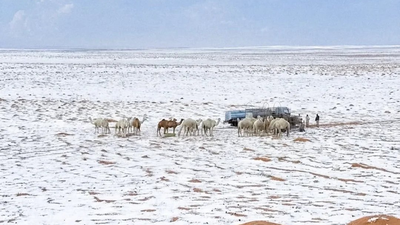
For the first time in three decades, snow has graced parts of Saudi Arabia, turning desert-framed mountains into icy landscapes and surprising residents with a rare winter spectacle. From snow-capped peaks to desert plains dusted in white, the Kingdom experienced a weather event that many had only imagined.
Snowfall across parts of Tabuk and the Trojena Mountains has transformed the regions into an unexpected winter playground, prompting residents to step outside to ski, play, and capture the rare icy scenes.
The Trojena Highlands were draped in white, turning the rugged northern mountains into a striking winter landscape. Visitors shared videos and photos on social media, capturing snow settling on rocky slopes.
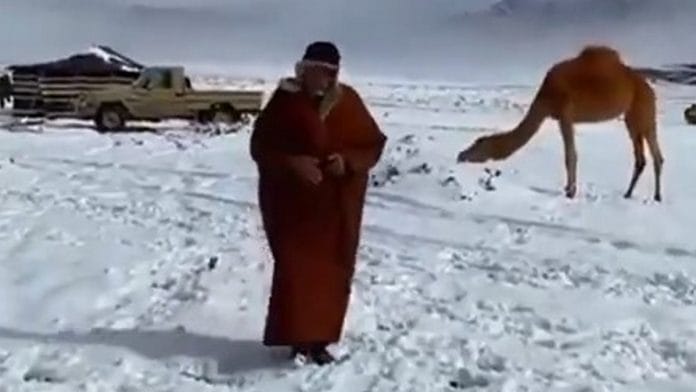
Residents of Al-Ahsa in the country’s eastern province, usually a warm area, also saw snowfall. The cold wave was accompanied by widespread rainfall across northern and central Saudi Arabia. Light to moderate rain was recorded in areas such as Bir Bin Hermas, Al-Ayinah, and Ammar.
So, why is it snowing in a country better known for extreme heat? And how rare is it?
Winter Games dreams
Snowfall in Saudi Arabia’s northern regions is rare but not unheard of. Elevated parts of Tabuk province have seen snow intermittently over the decades. What is different now is the scale and spread of snowfall across desert areas, something weather observers say has not been seen for decades.
The Saudi National Center of Meteorology (NCM) has said the most intense cold wave recorded in Saudi Arabia occurred in 1992. At its Hail station in the country’s northwest, temperatures dropped to a record low of –9.3°C in January that year. Reports also claim that in January 1973, a massive polar surge from Siberia brought nearly 20 cm of snowfall to Riyadh.
For the current cold wave, climate change is seen as a contributing factor. Experts from the World Meteorological Organisation have said the Arab region is warming at nearly twice the global average. This leads to what scientists call the “warming paradox”: as temperatures rise, the atmosphere holds more moisture, increasing the intensity of extreme weather events.
TV channels are calling it a “historic event”. In videos shared by social media users, residents can be seen playing with snow, with some clips even showing people snowboarding on desert slopes.
Snow blanketed Saudi Arabia this week, transforming the usually rugged, desert-framed mountains into a winter landscape.pic.twitter.com/0lMIazJe9b
— Massimo (@Rainmaker1973) December 19, 2025
Saudi Arabia, notably, is already making a colder future part of its economic strategy. Under Mohammed bin Salman’s Vision 2030, it is developing Trojena, a high-altitude winter destination in the Sarawat Mountains. Part of the larger $1.5 trillion Neom megacity project, it is set to host the Asian Winter Games in 2029.
Will there be more snow?
According to the National Centre for Meteorology, snowfall has also been observed in Al-Majmaah and Al-Ghat. Hussein Al‑Qahtani, the NCM’s official spokesperson, said the conditions were driven by a cold air mass pushing into central and northern regions, interacting with rain-bearing clouds. He added that temperatures were expected to remain low, especially across northern and central Saudi Arabia.
A deep low-pressure system moving in from the Mediterranean Sea has pushed very cold air south into the Arabian Peninsula. While snow does occasionally fall on Saudi Arabia’s high mountain peaks, it is far more unusual for it to blanket flat desert plains, as it has this week. In some areas, temperatures dipped to as low as -4°C, while other parts of the Kingdom were swept by rain.
No comments:
Post a Comment