Sunday, 16 April 2023

Dozens of Yemeni rebels fly from Saudi Arabia in prisoner swap

Dozens of Yemeni rebels fly from Saudi Arabia in prisoner swap

Dozens of Yemeni rebels fly from Saudi Arabia in prisoner swap


An exchange of nearly 900 prisoners from Yemen's civil war started on April 14, the biggest swap since 2020 [Saleh al-Obeidi/AFP]


A flight carrying rebel prisoners of war has left Saudi Arabia, bound for Yemen, as Saudi prisoners are set to be released later in the day, the International Committee of the Red Cross (ICRC) said.


On Friday, 318 prisoners were transported on four flights between government-controlled Aden and the rebel-held capital, Sanaa, reuniting with their families before next week’s Muslim holiday of Eid al-Fitr.


Saturday’s flight from the southern Saudi city of Abha took off before 9am (06:00 GMT), headed for Sanaa with 120 Houthi rebel prisoners, ICRC public affairs and media adviser Jessica Moussan said.


Standing on the tarmac at Sanaa International Airport, Mohammed al-Darwi, a Houthi prisoner released in the exchange, told Al Jazeera: “We are happy to return to Sanaa after we were in the prisons of the enemy.


At least three buses brought the prisoners onto the tarmac at Abha airport, which has previously come under attack from Houthi drones and missiles.


Wheelchairs were positioned near the buses to take some of the prisoners to the plane.


Sixteen Saudis and three Sudanese were expected to be transferred from Sanaa to Riyadh later on Saturday.


Sudan is part of the Saudi-led coalition and has provided ground troops for the fighting.


In addition, 100 Houthis were to be flown on three flights to Sanaa from al-Makha (Mocha) on the Red Sea coast, a town held by the coalition-backed government.


The prisoner exchange is a confidence-building measure coinciding with an intense diplomatic push to end Yemen’s war, which has left hundreds of thousands dead from the fighting as well as knock-on effects such as food shortages and lack of access to healthcare.


Path to peace?


Analysts say eight years after mobilising a coalition to crush the Houthis, the Saudis have come to terms with the fact this goal will not be met and are looking to wind down their military engagement.


Crown Prince Mohammed bin Salman, who was a 29-year-old defence minister when the war began, has since become the kingdom’s de facto ruler and is keen to focus on his sweeping “Vision 2030” domestic reform agenda.


The Saudi exit strategy appears to have taken new impetus from a landmark rapprochement deal announced with Iran last month.


“This [the prisoner swap] is the first concrete result of not only the Omani mediation, but also the Iran-Saudi agreement which is beginning to bear fruit in Yemen and elsewhere in the region,” Nabil Khoury, former US deputy chief of mission in Yemen, told Al Jazeera.


The China-brokered agreement calls for the Middle East heavyweights to fully restore diplomatic ties following a seven-year rupture, and has the potential to remake regional ties.


Saudi Arabia is also pushing for the reintegration into the Arab League of Iran ally Syria, more than a decade after its suspension over President Bashar al-Assad’s brutal crackdown on pro-democracy protests.


On Friday, the kingdom, which once openly championed al-Assad’s removal, hosted top diplomats from eight other Arab countries in the Red Sea city of Jeddah for talks on Syria. It issued a statement highlighting the “importance of having an Arab leadership role in efforts to end the crisis”.


Yemen prisoner exchange Returned Houthi prisoners pray on the tarmac upon arrival at Sanaa International Airport [Mohammed Huwais/AFP]


In Yemen, active combat has reduced over the past year following a United Nations-brokered truce that officially lapsed in October but has largely held.


A week ago, a Saudi delegation travelled to Sanaa, held by the Houthis since 2014, for talks aimed at reviving the truce and laying the groundwork for a more durable ceasefire.


The delegation, led by Ambassador Mohammed al-Jaber, left Sanaa late on Thursday without a finalised truce but with plans for more talks, according to Houthi and Yemeni government sources.


Even if Saudi Arabia manages to negotiate a way out of the war, fighting could flare up again among the different Yemeni factions.


“Saudi Arabia has been struggling to draw down its military involvement in Yemen and … seeks a long-term sustainable peace that will allow it to focus on its economic priorities,” said Sanam Vakil, director of the Middle East and North Africa Programme at Chatham House.


“Yet, despite its intention, it will be the longtime broker, investor and conflict guarantor of Yemen.”


Speaking from Washington, DC, former Yemeni detainee Hisham al-Omeisy agreed while the average Yemeni is desperate for peace, a real end to the war may be a long way still.


“A lot of people think that the end of the war will happen in a few weeks or months. I would caution against that,” he told Al Jazeera.


“It [peace] will take at least a year or two because the conflict is not just between the Houthis and the Saudis. It’s protracted and polarised with many parties and factions inside Yemen that need to be brought into an inclusive, holistic, and comprehensive [peace] process.”




Female bear that killed jogger gets stay of execution in Italy

Female bear that killed jogger gets stay of execution in Italy

Female bear that killed jogger gets stay of execution in Italy


A bear that killed a 26-year-old man while he was jogging in the woods close to a mountain village in northern Italy has been identified as a 17-year-old female that had previously attacked two people.


Andrea Papi, whose funeral was taking place on Wednesday, was the first person in Italy to be killed in a bear attack in modern times.


Prosecutors in the province of Trento identified the bear as JJ4, who had already been deemed dangerous after she attacked Fabio Misseroni and his son Christian close to a refuge hut on Monte Peller in June 2020


After that attack, the provincial governor, Maurizio Fugatti, issued an order for the animal to be captured and killed, but this was suspended by an administrative court after opposition from animal rights groups. The order was also challenged by Italy’s environment minister at the time, Sergio Costa.


It was agreed that the bear would instead be fitted with a radio collar. However, the battery for the device ran flat and so JJ4’s location was no longer traceable.


Misseroni and his son received serious wounds to the legs. On Wednesday, Misseroni told LaPresse news agency: “I don’t want to talk to anyone. I heard the news this morning and I feel really, really sick.”


Papi received injuries to his neck, arms and chest in the attack on 5 April near his village of Caldes. His family raised the alarm after he failed to return from his run. His body was found in a wooded area.


In a letter published by the Italian media on Tuesday, Papi’s mother, Franca Ghirardini, said her family “will fight to the end to get justice for my Andrea”. She wrote: “My soul and that of my family is devastated by immense pain, we can’t get over it. Knowing that Andrea was at the mercy of the bear devastates me.”


JJ4 was born in Trento after mating between two bears that had been brought to Italy from Slovenia in the early 2000s through Life Ursus, a project aimed at reversing the area’s dwindling brown bear population.


There are now about 100 bears in the Trento area, and close encounters with humans are becoming more frequent. A man was attacked by another bear, called MJ5, in the same province in March.


Fugatti has again issued an order for JJ4 to be captured and killed. Forest rangers will endeavour to capture the animal by enticing it with bait to walk into a “tube trap”, a device commonly used to capture bears.


In a statement last Friday, the Italian unit of WWF acknowledged that the bear would need to be put down once identified. WWF said seven people had been attacked by bears in Italy over the last 20 years and this was the first fatal attack.


Female bear that killed jogger gets stay of execution in Italy


An Italian court finally decided to sentence the she-bear to death for maltreating a runner which fatally ordered her execution to be suspended until May 11, officials in Trento say.


An ordinance signed by the tribunal of Trento was in response to a complaint filed by several wildlife protection agencies who petitioned the court to protect the 17-year-old bear named JJ4 by Italy's National Institute of Wild Fauna, but more commonly known as Gaia.


DNA samples found at the scene on a stick Andrea had used to defend himself and, on his clothes, and body had positively identified the 17-year-old female bear as the culprit.


It later emerged that the bear had also been involved in another attack in 2020 that left a dad and his son badly injured after they were forced to flee for their lives.


The incidents all took place on Mt Peller close to Caldes in the northern Italian region of Trentino where around 100 bears are believed to be living after being reintroduced there in 2000.


Posting a picture of a baby bear cub on its mother, LAV wrote on their Twitter feed: 'The order has been suspended by the regional tribunal which accepted our requests.


'The arrogance of the regional president Maurizio Fugatti has been beaten. Bears and the citizens of Trentino have the right to live in peace.' In a statement LAV said: 'It's evidently clear the desire of Mr Fugatti, he has no intention of working with us for a peaceful solution between bears and humans.


'What he wants is a vendetta towards bears, all he wants to do is kill them or move them out of the area.


'There is an alternative possibility for these animals, even for the one that he has ordered to be killed. These bears can all be saved.


'All the local authorities need to do is run a proper informative campaign for the local population and for holidaymakers so they know what to do if and when they see a bear.


Mr Fugatti said: 'In 2020 we authorised the killing of Jj4 after she attacked two people on Mt Peller.


'We have highlighted numerous times to various authorities that Jj4 is a dangerous bear but we have always been defeated and told that she is not dangerous and she should be free.


'But we cannot have dangerous animals circulating freely in our forests and countryside.'


Mr Fugatti said he would be calling for an urgent meeting between regional authorities and animal rights groups to 'urgently discuss' the situation.


In a statement issued by her lawyer Andrea's mother Franca, said: 'It's not my son's fault and not even the bear's - shooting the bear won't give me back Andrea.'


'The management of this project, over time, has become increasingly incautious and inadequate and has not taken into account and evaluated the growth in the number of bears and the population.


'We as a family, demand that somebody be held responsible for the lack of protection and prevention, they can't get away with it.'


Judge Fulvio Rocco said he had suspended the order pending further evidence from both parties and adjourned the case until May 11.


The original 2020 was overturned after it emerged that Jj4 - also known as Gaia - had given birth to bear cubs.


Jj4 was born after two bears from Slovenia were brought to Italy through a project called Life Ursula, which aims at increasing the dwindling bear population.


Following the 2020 attack the Jj4 was fitted with an electric collar but the battery has since run out and officials have been unable to replace it.


A message on the website of the local council which oversaw the tracking said that 'due to a technical fault the current whereabouts of Jj4 were unknown'.


Japan PM Kishida unhurt in 'smoke bomb' scare, resumes campaigning

Japan PM Kishida unhurt in 'smoke bomb' scare, resumes campaigning

Japan PM Kishida unhurt in 'smoke bomb' scare, resumes campaigning


Japanese Prime Minister Fumio Kishida was evacuated unhurt after a suspect threw what appeared to be a smoke bomb at an outdoor speech in western Japan on Saturday.


Kishida took cover after a loud explosion was heard while police subdued a man at the scene, Japanese media footage showed. A police officer suffered minor injuries in the incident, the Nikkei newspaper reported, citing Wakayama prefectural police.


"Police are investigating the details of the loud explosive sound at the previous speech venue," Kishida said when he resumed his campaign speeches. "I am sorry for causing many people to be concerned. We are in the middle of an important election for our country. We must carry this on together."


The incident echoed the assassination of former Prime Minister Shinzo Abe, Japan's longest-serving modern leader, who was shot with a homemade gun last July while campaigning for a parliamentary election.


Abe's killing shocked the nation, where gun crimes are exceedingly rare, and prompted a review of security for politicians, who routinely press the flesh with the public.


Masato Kaburagi, a 35-year-old company worker who witnessed the incident, told Reuters security still seemed lax, as it appeared the suspect was first taken down by another bystander.


"I never thought something like this would happen so soon after what happened to Abe," said Kaburagi, who attended the rally with his wife and mother. "I don't think I want to go to these political-related events anymore."


By-elections in various regions for the lower house of Japan's parliament are to be held on April 23.


G7 SUMMIT SECURITY UNCHANGED


Chief Cabinet Secretary Hirokazu Matsuno said police have been instructed to boost security, and that the government will do what is necessary to ensure security at a summit Kishida will host next month of the Group of Seven industrial powers in Hiroshima.


A man, believed to be a suspect who threw a pipe-like object near Japanese Prime Minister Fumio Kishida during his outdoor speech, is held by police officers at Saikazaki fishing port in Wakayama, Wakayama Prefecture, south-western Japan April 15, 2023, in this photo released by Kyodo. Mandatory credit Kyodo via REUTERS


Japan's foreign ministry said there would be no change to the security plan for a G7 foreign ministers' meeting starting on Sunday in the resort city of Karuizawa.


Matsuno said the government would wait for results from the police investigation before commenting on a potential motive from the suspect.


The incident late on Saturday morning occurred at the Saikazaki fishing harbour in Wakayama prefecture, some 65 km (40 miles) southwest of Osaka city.


Matsuno said the government would wait for results from the police investigation before commenting on a potential motive from the suspect.


The incident late on Saturday morning occurred at the Saikazaki fishing harbour in Wakayama prefecture, some 65 km (40 miles) southwest of Osaka city.


Kishida was being served local speciality seafood just before the explosion, media reported. News video showed Kishida looking behind him in surprise as shouts filled the semi-enclosed area near the waterside. A canister landed near his feet before being knocked away by a security agent.


A man identified by the Asahi newspaper as a staffer of the fishery cooperative grabbed a young man in a headlock as police swarmed the suspect and dragged him to the ground. About 50 seconds later, an explosion rang out and a cloud of smoke could be seen near where Kishida had been standing.


News footage showed crowds running away as several police officers appeared to pin a man to the ground before removing him from the scene. A 20-30 cm (8- to 12-inch) metal pipe was thrown and landed close to where Kishida was standing, NHK reported, citing an official at the scene.


A 24-year old male suspect from Kawanishi city, charged with forcible obstruction of business, has refused to talk until his lawyer arrives, Kyodo news agency said, citing investigators.


A representative of Wakayama's prefectural police headquarters told Reuters he could not answer questions about the incident.


A woman on the scene told NHK that she saw an object flying overhead and "it gave me a bad feeling, so we ran away unbelievably fast. Then we heard a really loud noise. It made my daughter cry."


How Jeddah residents are reviving old Ramadan traditions

How Jeddah residents are reviving old Ramadan traditions

How Jeddah residents are reviving old Ramadan traditions


Jeddah - As one walks through Bab Jadid, one of Jeddah’s old gates and the northernmost entry to the city’s historic downtown area, the muffled sounds of pedestrians and street vendors can be heard, growing louder with each step until you are transported to a time and place in which hospitality, kinship, community and tight bonds characterized the way of life.


The walkway that leads to Al-Hazzazi courtyard, one of the area’s most vibrant hubs, is lined by centuries-old homes. The farther you go, the louder the sounds grow and the brighter the decor becomes, with colorful pennants and banners bearing the greetings “Ramadan Mubarak” or “Ramadan Kareem” hanging overhead.


Children rush through the crowds to get their sugar fix from traditional sweet vendors, and pedestrians line up to eat “dirty potatoes” (the Saudi version) covered in a concoction of sauces. Couples stroll casually as they quench their thirst after a long day of fasting with cold, mixed berry juices sold by a woman clad in a traditional head wrap, and groups of Western tourists make their way through tiny alleyways on their way to the next vibrant courtyard.


Young boys join a crowd to get their share of traditional Ramadan sweets at a street in Jeddah's Al-Balad. (AN photo by Huda Bashatah)


In short, the area, a UNESCO World Heritage Site and one of the Kingdom’s most unique cultural hubs, is alive with Hijazi flair.


The Saudi Ministry of Culture’s Ramadan Season celebrates the historical legacy of the holy month across more than 38 locations in 14 Saudi cities.


Saudi Arabia’s western Hijaz region takes this a step further. The cobbled stone pathways bear the markings of a city that has withstood the sands of time: The twists and turns of tiny alleyways, grand multistory, white-washed stone homes dotted with exquisite woodwork, the Roshan, and string lights lining the pathway give the site a local and humble feel.


The Hijazi neighborhoods in Jeddah's Al-Balad come alive every Ramadan night as people from all walks of life pour in to savor the food, sights and sounds of old. (AN photo by Huda Bashatah)


The holy month of Ramadan, the ninth month of the Islamic calendar, is not only special spiritually — it urges communities to unite and welcome others.


“Growing up, I would always find extra plates on a table at every iftar meal,” Abu Abdul Aziz Diyab, one of the last Saudis still living in the downtown area, told Arab News.


“My mother and our neighbors would exchange plates almost every day, a tradition still practiced till this day. I grew up in these neighborhoods and I can never leave. It’s alive and busy with people from all walks of life. It’s a humble place, always welcoming, and a melting pot of cultures and traditions.”


Within the walls of the homes of Hijazi families, he added, ancient traditions, including food and songs, are kept alive while millions visit the area each year to relive the old days and pass on an appreciation of the beauty of the sights and sounds to younger generations.


Visitors from far and wide come to experience all aspects of an authentic Hijazi Ramadan. Some arrived during the Easter holiday last weekend to explore the city and region.


Men dressed in the traditional Hijazi attire relives the glory days of Jeddah at his nook and cranny in Al-Balad. (AN photo by Huda Bashatah)


In the old days, water boys known as al-saga walked around neighborhoods announcing that fresh barrels of water were available. Street vendors chanted catchy jingles as they sold baleela, a dish of boiled chickpeas served with hot sauce, pickled beets and tamarind sauce topped with a dash of cumin or freshly fried spiced liver pieces with a tomato and onion base.


Vegetable and fruit stalls dotted the marketplace, and the drum-beating musaharti awoke sleepy households after the last of the evening prayers so that they could have their last meal before beginning their fast at dawn. Such scenes and activities were common, and some can still be seen today.


Characters portraying some of the most important figures in the historic days of Jeddah walk among the crowds as a means of telling a story. Al-saga, or waterboy, was an essential pillar of the community. (AN photo by Huda Al-Bashatah)


Food vendors still offer fresh homemade cheeses, pickles and traditional desserts in preparation for the Eid festivities at the end of Ramadan in Souk Al-Aluwi, Souk Al-Baddu, Souk Gabil and Souk Al-Nada, spread across the four central neighborhoods of Harat Al-Sham, Harat Al-Mazloom, Harrat Al-Yemen and Harat Al-Bahar.


All these things were once common in Jeddah, Makkah, Madinah, though some, such as the al-saga and musaharati, have largely disappeared due to the expansion of cities, modern amenities, the migration of families, and technology such as alarm clocks


Food vendors are spread across Al-Balad's four central neighborhoods, offering traditional snacks and desserts. (AN photo by Huda Al-Bashatah)


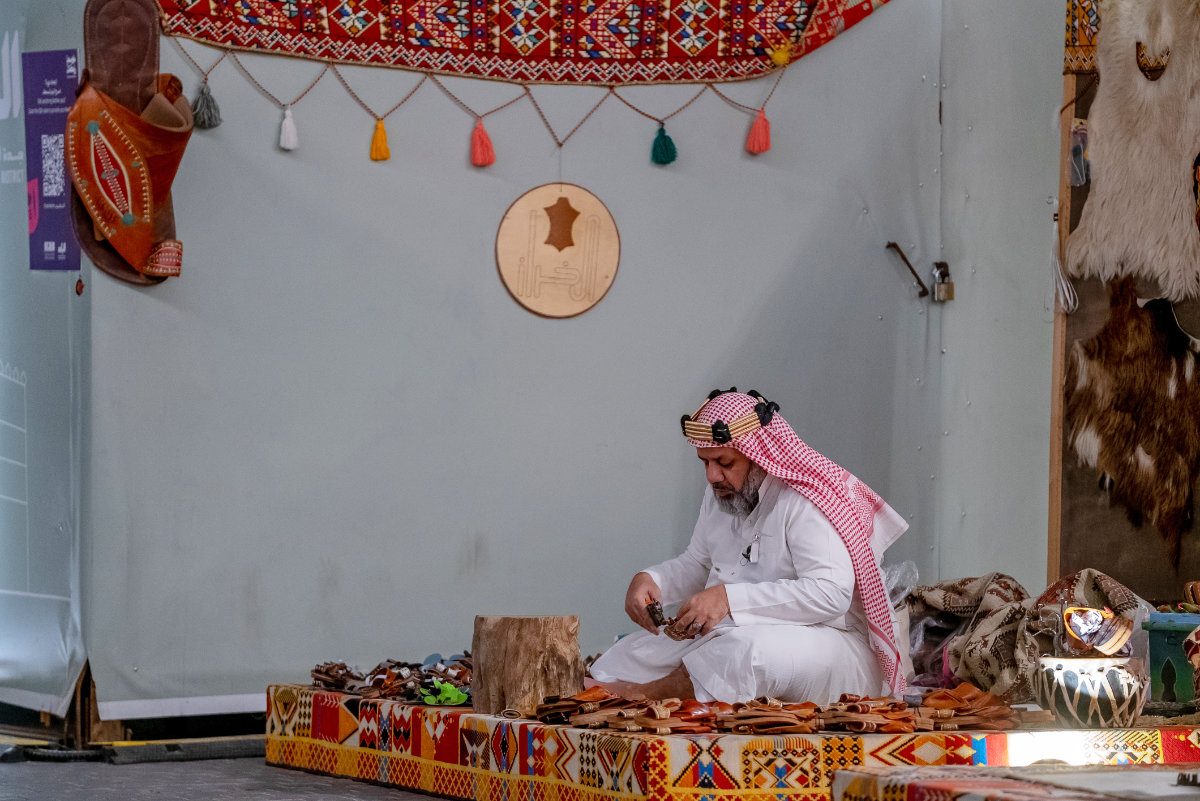
In Jeddah’s historic Al-Balad, spectators smile and take photographs of a passing procession of kids chanting for candy. Others snap photos of craftsmen wrapping black wool around igal megassab, a headpiece for men made of black cord fixed on a goat wool core forming a hoop with thick gold cords that form a pentagon, or making leather belts, knife holders or traditional slippers known as madas sharqi. Others are in search for a quick bite to eat after a long evening of shopping in nearby shops.


Arif Al-Sharif, who refers to himself as “honorary mayor of downtown Jeddah” during Ramadan, wears a black shemagh held on his head by an iqal megassb, and a leather belt from which hangs a gold dagger. Al-Sharif, a fashion designer known for his authentic traditional clothing, told Arab News that the essence of the area is what keeps it full of life.


“Every year, figures such as the mayor play a part in the festivities to tell the story of his prominence and status among the people of the area,” he said.


"A mayor is selected for his wisdom to solve problems without needing to go to a court of law, discretely provide for needy families through the charity of the city’s residents, call for order, and he is a keeper of secrets. This is how Jeddah mayors were. I come every evening to engage with the visitors and passersby, telling the story of the people who once lived here


“We have to keep the unique and exceptional culture and traditions alive through the art of storytelling and engagement. It’s the Hijazi way.”


So far, more than 700,000 people of an expected one million have visited Al-Balad during Ramadan this year.


Two Hungarian tourists, college student Timea Vincze and her cousin Bea Sipos, a financial analyst from Budapest, told Arab News that they have visited Al-Balad three times during their 10-day stay in the Kingdom.


Timea Vincze and Bea Sipos came all the way from Hungary to visit the UNESCO Heritage Site. (AN photo by Huda Bashatah)


“I didn’t expect it to look so nice; it’s very authentic and very different from Europe, as we don’t really have these kinds of downtowns … it’s amazing,” said Sipos.


She said her favorite part of Jeddah is “definitely the old town. The vibe here is really unique, so all these buildings (are) amazing. It’s totally empty during the day; I think that’s a good thing in Ramadan for us so we can visit when it’s totally empty, and at night it’s so busy with so many people.”


Vincze said: “It’s really beautiful here and I just can’t get enough. I think the buildings are very interesting, very different from what we have in my country or in Europe. It’s beautiful. It’s part of UNESCO and I hope it will be the same in a few years because it’s very unique and beautiful.


“The people were very nice to us; many would come (over) and just smile at us. I have never seen this kind of kindness in another country, and they’re also helpful, asking us where we’re from and telling us to enjoy our time. That’s very heartwarming.”


Locals relive the good old days as Al-Balad undergoes a massive turnaround after decades of neglect. (AN photo by Huda Bashatah)


Al-Balad’s walls echo to the sounds of celebration and joy, and although the area was once rather rundown as a result of neglect, it has undergone a massive turnaround and is reliving its glory days.


In 2021, the Ministry of Culture launched its Jeddah Historical District Program to revive the downtown area, establish several cultural hubs, and elevate it to the world-class urban center it once was.


As a result, it is once again alive with the sounds of locals and visitors as the ministry continues to work to position the historic district as the nexus of a cultural network, while supporting Jeddah's traditional role as the gateway to the holy sites of Makkah and Madinah.


Saturday, 15 April 2023

250,000 perform final Friday Ramadan prayers at Al-Aqsa

250,000 perform final Friday Ramadan prayers at Al-Aqsa

250,000 perform final Friday Ramadan prayers at Al-Aqsa


Palestinians pray on the fourth Friday of the holy month of Ramadan on Al-Aqsa. (Reuters)


A massive Israeli security presence lined the streets of Jerusalem as up to 250,000 Palestinian Muslims performed the fourth and probably final Friday prayer of Ramadan at Al-Aqsa Mosque.


More than 3,200 police, border police and Shin Bet security agents were deployed on roads leading to the mosque.


Authorities allowed women of all ages, men over the age of 55 and children under 12 to enter Jerusalem from the West Bank without permits to perform Friday prayers.


Ramadan is a rare chance for many Palestinians to visit Jerusalem and pray at Al-Aqsa. For many, this was their first time in the city


Ahmed Khassib, 51, from Ramallah, told Arab News: “I am delighted to be able to perform the fourth Friday prayer of Ramadan at Al-Aqsa Mosque.


“I cannot obtain a permit to pray at Al-Aqsa Mosque except on Fridays during Ramadan, so I wait for this opportunity throughout the year.”


Praying at the mosque, Khasib said, “carries a message that Al-Aqsa is for Muslims.”


During his Friday sermon, Sheikh Ekrimeh Sabri, the imam of Al-Aqsa Mosque, told worshippers: “You who came to the blessed Al-Aqsa Mosque from all parts of holy Palestine, you who have crossed the unjust military checkpoints, your march to the blessed Aqsa for the evening prayer and Taraweeh prayers is to remind the 2 billion Muslims of the world of the captive Al-Aqsa.”


Abd Al-Salam Abu Askar, a Palestinian from the Gaza Strip who lives in Ramallah, told Arab News that inflammatory comments about Al-Aqsa by far-right Israeli National Security Minister Itamar Ben-Gvir had made Palestinians more determined to challenge Israeli restrictions on worshipping there.


When they felt the mosque was in danger, he said, they flocked to it during Ramadan, especially on Fridays.


“If the military checkpoints surrounding the city of Jerusalem allowed all citizens of the West Bank and Gaza Strip to visit Al-Aqsa, the number of worshippers would exceed half a million today,” Abu Askar said.


The Temple Mount and Al-Aqsa Mosque turned into fortress since Thursday night and extra security forces were put into service for the peaceful Friday prayers of Ramzan. This Friday also coincides with Quds Day, observed by Shi’ite Muslims in Iran, Syria, Lebanon among other places.


There was tight security at checkpoints leading to Jerusalem. Israeli police placed Iron barriers in the streets and alleys of the Old City in Jerusalem, at most of the mosque’s gates, and Bab al-Amound area.


Israel police detained eight suspects for questioning after the Friday prayers at Al-Aqsa mosque. According to a report by The Jerusalem Post, the suspects, who had their faces covered with masks, waved flags and banners supporting terror organisations and shouted incitements to violence.


The report further mentioned military officials saying that “numerous attacks in the West Bank and the Jerusalem area were thwarted at the last minute by the IDF and Shin Bet.”


Clashes at Al-Aqsa mosque compound


On 5 April, clashes broke out at Al-Aqsa mosque compound after Israeli police attacked Palestinians, sparking a military exchange of rockets and air strikes. Two more rockets were fired late Wednesday from the Israel-blockaded Gaza Strip towards Israel leading to fresh altercations at Al-Aqsa mosque during the Jewish Passover and the Muslim holy month of Ramadan.


Armed police in riot gear stormed the prayer hall of Al-Aqsa mosque before dawn last Wednesday, aiming to dislodge “law-breaking youths and masked agitators” they said had barricaded themselves inside.


A barrage of rocks and fireworks met the officers, police video showed, and more than 350 people were arrested.


Security forces are also on alert in the West Bank following warnings about possible terror attacks and are continuing the search for a terror cell that killed Lucy Dee and her daughters, Maia and Rina.