Monday, 12 January 2026

Ketua Federal Reserve Powell says Trump administration has threatened him with a criminal indictment

Ketua Federal Reserve Powell says Trump administration has threatened him with a criminal indictment

Ketua Federal Reserve Powell says Trump administration has threatened him with a criminal indictment


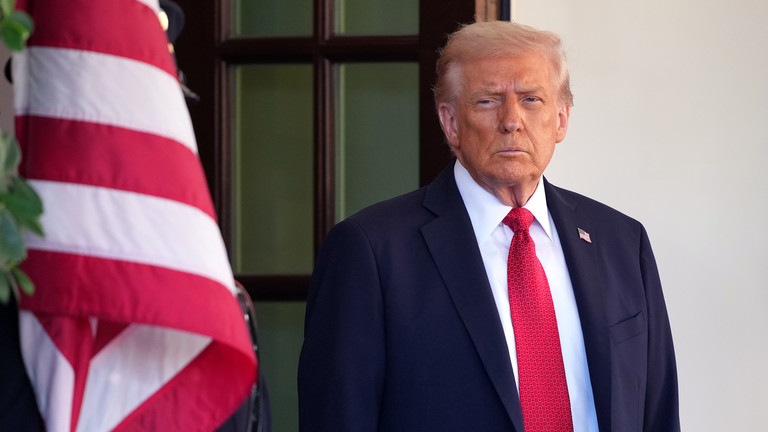
U.S. President Donald Trump and Federal Reserve Chair Jerome Powell speak during a tour of the Federal Reserve Board building, which is currently undergoing renovations, in Washington, D.C.,... Purchase Licensing Rights


The Trump administration has threatened to indict Federal Reserve Chair Jerome Powell over Congressional testimony he gave last summer about a Fed building project, an action Powell called a "pretext" to gain more influence over the central bank and monetary policy.


The development in the long-simmering effort by President Donald Trump for greater control over the Fed had immediate fallout, with Republican Senator Thom Tillis, a member of the Senate Banking Committee that vets Presidential nominees for the Fed, saying in a statement on X that the threatened indictment puts the Department of Justice's "independence and credibility" in question.


Tillis said he would oppose any Trump nominees to the Fed, including the president's coming choice of a new chair, "until this legal matter is fully resolved."


Powell revealed the subpoenas and threats in a Sunday night statement.


"On Friday, the Department of Justice served the Federal Reserve with grand jury subpoenas, threatening a criminal indictment related to my testimony before the Senate Banking Committee last June,"


Powell said. "I have deep respect for the rule of law and for accountability in our democracy. No one—certainly not the chair of the Federal Reserve—is above the law."


"But this unprecedented action should be seen in the broader context of the administration’s threats and ongoing pressure" for lower interest rates and more broadly for greater say over the Fed, he said.


"This new threat is not about my testimony last June or about the renovation of the Federal Reserve buildings. It is not about Congress’s oversight role...Those are pretexts. The threat of criminal charges is a consequence of the Federal Reserve setting interest rates based on our best assessment of what will serve the public, rather than following the preferences of the President."


Trump told NBC News Sunday that he had no knowledge of the Justice Department's actions. “I don’t know anything about it, but he’s certainly not very good at the Fed, and he’s not very good at building buildings,” Trump said.


A Justice Department spokesperson declined to comment on the case but added: “The Attorney General has instructed her US Attorneys to prioritize investigating any abuse of tax payer dollars.”


POWELL INQUIRY A 'LOW POINT' IN TRUMP PRESIDENCY


Trump has demanded the Fed cut rates sharply since resuming office in January, blaming its policy for holding back the economy and musing about firing Powell despite the legal protections ostensibly covering the Fed chair from removal. He is also trying to fire Fed Governor Lisa Cook in a case that is now pending before the Supreme Court.


The independence of central banks, at least in setting interest rates in order to control inflation, is considered a central tenet of robust economic policy, insulating monetary policymakers from short-term political considerations and allowing them to focus on longer-term efforts to keep prices relatively stable.


The inquiry into Powell “is a low point in Trump's presidency and a low point in the history of central banking in America,” said Peter Conti-Brown, a Fed historian at the University of Pennsylvania. “Congress did not design the Fed to reflect the president's daily fluctuations, and because the Fed has rebuffed President Trump's efforts to take the Fed down he is launching the full weight of American criminal law against its Chair.”


Financial markets reflected little change in near-term expectations for Fed policy even after Powell's term as chair ends in May, with rate-futures continuing to price in two rate cuts for the year.


The dollar fell and U.S. equity futures slid on the latest news, but the moves were relatively modest so far.


LATEST TRUMP ADMINISTRATION MOVES MARK TURNING POINT?


The subpoenas and statement by Powell mark a stark shift in the now longstanding battle between Trump and Powell. Trump elevated Powell to the chair's job during his first term, but quickly soured on him and made his opinions clear in a series of rebukes and threats.


Powell, for his part, had largely eschewed comment on the president's actions or statements, instead acknowledging that chief executives often express opinions about a variety of issues, and pledging, as he did in the Sunday statement, to "continue to do the job the Senate confirmed me to do."


However, the Trump administration's latest moves, coming within months of the end of Powell’s term as chair in May, appear to have marked a turning point, with Powell directly accusing the administration of using the legal system to try to achieve its goal of getting the Fed to lower interest rates further and faster than the central bank's body of 19 policymakers feels is appropriate.


While Powell's term as chair ends in May, he has the right to continue on the Fed board until January 31, 2028, depriving the president of an additional Fed appointment - what would be Trump's fourth on the seven-member board - until near the end of his term.


The White House began early last year criticizing the Fed's $2.5 billion renovation of two of its buildings in Washington, describing it as overly costly and ostentatious.


Some analysts at the time did call it a pretext for the Trump administration's pressure campaign for lower interest rates, but Powell did not. The Fed chair instead posted detailed explanations of the work on the central bank's website and sent letters to members of the Trump administration providing background.


In June, when Powell gave his usual twice-yearly testimony on monetary policy to Congress, he was asked repeatedly about the work, which he explained as being necessary updates to outdated infrastructure. In July Trump made a rare presidential visit to the site, and Powell gave him a tour.



Saturday, 10 January 2026

Video - US seizes another oil tanker in Caribbean

Video - US seizes another oil tanker in Caribbean

Video - US seizes another oil tanker in Caribbean


The American military has captured a fifth tanker amid its Venezuela blockade


©X/Southcom


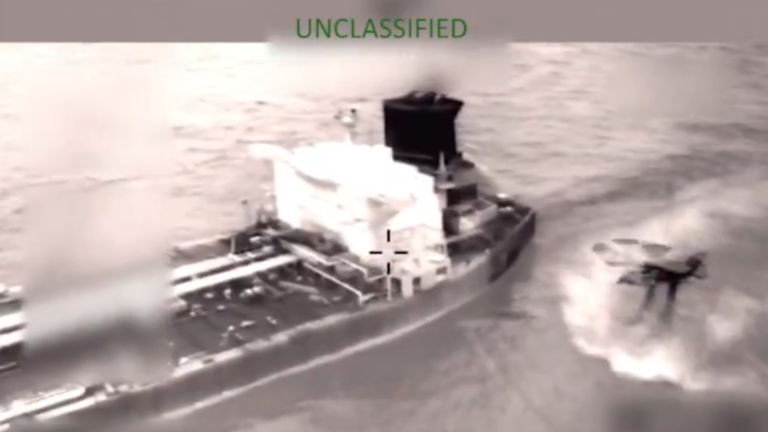
The US military has announced the seizure of another oil tanker in the Caribbean Sea, claiming the move is part of efforts aimed at “ending illicit activity and restoring security in the Western Hemisphere.”


The vessel, the Olina, was boarded without incident early on Friday morning, the US Southern Command said in a statement. The tanker was said to have been flying the flag of Timor-Leste at the moment it was boarded. It was reportedly previously spotted traveling from Venezuela and had recently returned to the region.


“The Department of War’s Operation Southern Spear is unwavering in its mission to defend our homeland by ending illicit activity and restoring security in the Western Hemisphere,” the command said.


Footage released by the US military shows a large, heavily armed group of servicemen disembarking from a helicopter hovering above the tanker. The servicemen are then seen heading to the vessel’s superstructure.


The Olina is the fifth vessel to be seized by the US amid the blockade imposed on Venezuela. Earlier this week, the US military took control of two tankers believed to be linked to the country, the Sophia and the Marinera, previously known as Bella 1. The former vessel was apprehended in the Caribbean without incident.


The latter tanker had been pursued by the US Coast Guard since late December, when its crew refused to allow American servicemen on board and headed for the Atlantic from the Caribbean.


During the pursuit, the ship secured a temporary sailing permit from Russia, switching to the country’s flag and changing its name.


The vessel was ultimately intercepted on Wednesday in international waters northwest of Scotland in a large-scale US military operation, backed by the UK. Moscow has condemned the seizure of the vessel as a gross violation of international maritime rules and a breach of the UN Convention.


Friday, 9 January 2026

AS merusak 'tatanan dunia' – Presiden Jerman

AS merusak 'tatanan dunia' – Presiden Jerman

AS merusak 'tatanan dunia' – Presiden Jerman


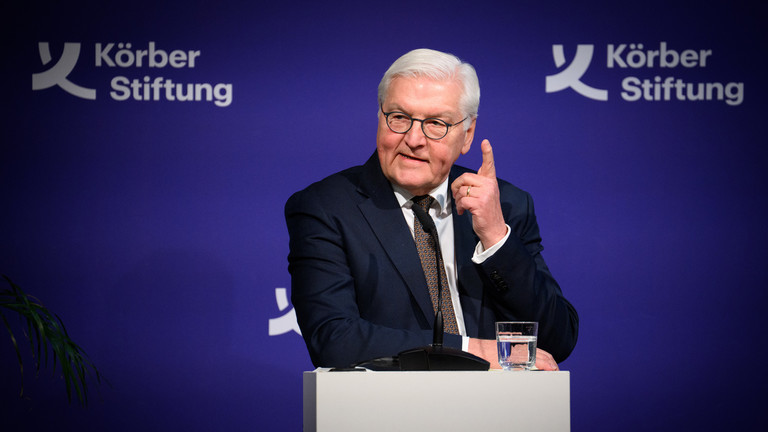
Frank-Walter Steinmeier telah memperingatkan agar politik global tidak berubah menjadi “sarang perampok”.


Presiden Jerman, Frank-Walter Steinmeier berbicara di sebuah acara di Berlin pada 7 Januari 2026. ©Bernd von Juterczenka/picture alliance/Getty Images


Presiden Jerman Frank-Walter Steinmeier mengatakan bahwa pengabaian norma-norma internasional oleh AS membuat dunia menjadi lebih berbahaya.


Pernyataan tersebut disampaikan setelah Presiden AS Donald Trump memerintahkan serangan komando ke Venezuela, menculik presidennya, Nicolas Maduro, dan memperbarui rencana untuk menguasai Greenland dari Denmark.


“Terjadi kerusakan nilai-nilai oleh mitra terpenting kita, AS, yang membantu membangun tatanan dunia ini,” kata Steinmeier pada hari Rabu selama simposium di Yayasan Koerber yang diadakan untuk menghormati ulang tahunnya yang ke-70, seperti dikutip oleh Reuters.


Ia mendesak upaya untuk mencegah “dunia berubah menjadi sarang perampok, di mana orang-orang yang paling tidak bermoral mengambil apa pun yang mereka inginkan, di mana wilayah atau seluruh negara diperlakukan sebagai milik beberapa kekuatan besar.”


“Upaya sedang dilakukan untuk mendorong negara-negara berukuran sedang sekalipun – dan itu termasuk kita – ke pinggiran sejarah, sementara negara-negara kecil dan lebih lemah dibiarkan sepenuhnya tanpa perlindungan,” tambah Steinmeier.


Presiden Prancis Emmanuel Macron juga memperingatkan tentang “risiko terhadap tatanan internasional tempat kita hidup.”


“Amerika Serikat adalah kekuatan yang mapan, tetapi secara bertahap menjauh dari beberapa sekutunya dan melepaskan diri dari aturan internasional yang masih dipromosikannya hingga baru-baru ini, baik dalam perdagangan, aspek keamanan tertentu, atau berbagai forum internasional,” kata Macron kepada korps diplomatik Prancis di Paris pada hari Kamis. Sebelumnya ia mengatakan bahwa ia tidak menyetujui “metode” penggulingan Maduro oleh AS.


Trump mengatakan kepada The New York Times dalam sebuah wawancara yang diterbitkan pada hari Kamis bahwa ia tidak “membutuhkan hukum internasional,” dan bahwa ia mengandalkan penilaiannya sendiri. “Moralitas saya sendiri. Pikiran saya sendiri. Hanya itu yang dapat menghentikan saya,” katanya.


AS menggambarkan aksi militernya di Venezuela sebagai operasi kepolisian untuk menangkap Maduro, yang dituduh Trump melakukan perdagangan narkoba. Maduro mengaku tidak bersalah ketika dibawa ke hadapan hakim New York pada hari Senin, dan menyebut dirinya sebagai "tawanan perang." Venezuela mengutuk serangan AS tersebut sebagai pelanggaran terang-terangan terhadap kedaulatannya.


Gaza, Venezuela, Ukraine - The fault lines shaping 2026

Gaza, Venezuela, Ukraine - The fault lines shaping 2026

Gaza, Venezuela, Ukraine - The fault lines shaping 2026


By Professor Alexey Makarkin, vice president of the Center for Political Technologies


This year could be a turning point for Trump’s foreign policy, and for the balance of power.


US President Donald Trump ©Kevin Dietsch/Getty Images


By the end of 2026, we will have a clearer sense of whether Donald Trump’s claims to a new model of American dominance are real, or whether this project turns out to be largely rhetorical. Several geopolitical fronts will act as indicators of how far Washington can actually reshape the international order.


The first of these is Gaza. The opening stage of Trump’s plan has already been carried out. The next test will be whether the United States is able to create a functioning administration there, backed by security forces capable of protecting it. This task is complicated by the fact that Hamas has been weakened, but not eliminated. Its influence within Gaza will have to be taken into account, while for Israel such a presence remains categorically unacceptable. In 2026 we will see whether Washington is capable of managing such an inherently contradictory reality, or whether the project collapses under internal tensions.


The second key arena is Venezuela. Trump has clearly invested political capital in removing Nicolas Maduro. By forcing change in Caracas at what appears to be minimal cost, it will strengthen America’s position not only in Latin America, but globally.


Ukraine represents a third, though more cautious, test of Trump’s foreign-policy approach. Here the stakes are lower for Washington, and the style of involvement more restrained. The United States is relying largely on informal contacts and the belief that favorable economic arrangements can gradually neutralize even deep-rooted geopolitical conflicts. Whether this assumption proves correct will also become clearer in 2026.


All of this will unfold against a tight political timetable. The US midterm elections in November 2026 may sharply restrict Trump’s room for maneuver. After that point, he risks becoming a lame duck, which explains why the administration is eager to resolve its major foreign-policy dilemmas before then.


For Western Europe, 2026 is also shaping up to be a decisive year. It will test whether the rearmament drive begun in recent years can be sustained, and it will serve as a prelude to the 2027 French presidential election. Either the French establishment will manage to produce a new centrist figure in the mould of Emmanuel Macron, or Marine Le Pen’s protégé, Jordan Bardella, may come to power. He will likely promise to preserve the military alliance with the US while fundamentally reshaping the EU’s internal architecture. Germany, meanwhile, faces its own trial: if Friedrich Merz’s government fails to revive economic growth, the stability of the ‘grand coalition’ will be called into question.


The BRICS world will also face serious challenges. In China, 2026 will be a year of preparation for the 2027 Party Congress, which will determine whether Beijing continues along the path of highly centralized personal rule or returns to the more collective, oligarchic governance model associated with Deng Xiaoping. At the same time, China’s relationship with the US will be further strained by Trump’s decision to supply Taiwan with major arms packages, raising the question of whether Beijing is ready for prolonged confrontation.


India and China may also see tensions shaped by developments in Bangladesh, where the pro-Indian government fell in 2024 and a new leadership with closer ties to Pakistan, and by extension to China, has emerged.


Finally, Brazil’s presidential election may become the most serious test for BRICS as an institution. Lula currently leads the polls, but if Bolsonaro’s camp returns to power, Brazil’s commitment to the grouping may weaken sharply, especially given Trump’s skeptical attitude toward BRICS in his current term.


As a result, 2026 will be a difficult year for an already fragmented world. Trump’s ambitions will accelerate many of the contradictions that have been accumulating in global politics. Some leaders still dream of a return to the predictable international order of the past, but such ‘normality’ is unlikely to return in the year ahead.


Saturday, 3 January 2026

Russia condemns US ‘aggression’ against Venezuela

Russia condemns US ‘aggression’ against Venezuela

Russia condemns US ‘aggression’ against Venezuela


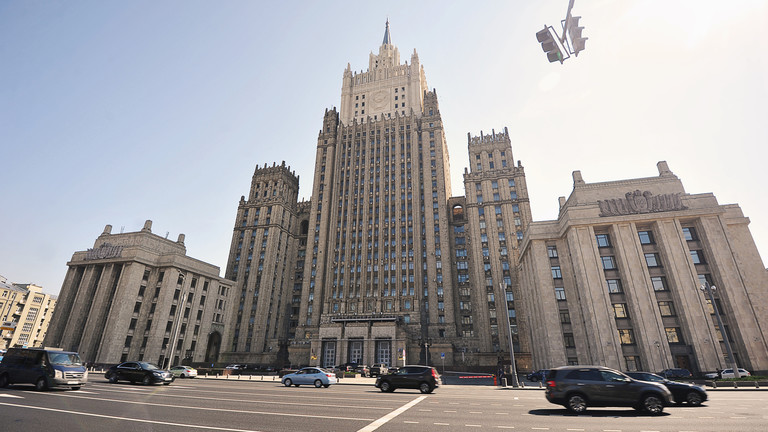
Ministry of Foreign Affairs in Moscow, Russia. ©Getty Images/fordeno


The US president has claimed that Venezuelan leader Nicolas Maduro has been captured and flown out of the country Russia condemns US ‘aggression’ against Venezuela.


Russia’s Foreign Ministry has condemned what it called a US act of “armed aggression” against Venezuela on Saturday, calling for restraint and warning against further escalation. US President Donald Trump has confirmed strikes took place, claiming that Venezuelan President Nicolas Maduro has been captured and flown out of the country.


Venezuelan officials earlier said the country had been directly attacked by the US after explosions were heard in the capital, Caracas, on Saturday. Foreign Minister Yvan Gil accused Washington of trying to gain control of the Latin American nation’s natural resources.


Moscow reaffirmed its solidarity with the Venezuelan people and supported calls for an urgent UN Security Council meeting. The foreign ministry stressed that Latin America should remain a zone of peace and that Venezuela must be free to determine its own future without external interference.


Leonid Slutsky, chairman of the State Duma’s Foreign Affairs Committee, described the latest strikes on Venezuela as a US military operation aimed at changing an “undesirable” regime, accusing Washington of seeking to impose its will on the country.


Venezuela declared a state of emergency shortly after explosions. The government has said the attacks also took place in the states of Miranda, Aragua, and La Guaira.


The strikes come amid heightened tensions between Washington and Caracas. Trump has repeatedly accused Venezuela’s government of facilitating large-scale drug trafficking and has authorized expanded US military operations targeting suspected smuggling routes in the Caribbean and eastern Pacific.


Maduro has rejected the allegations, accusing the US of aggression and of using anti-drug operations as a pretext to topple his government. He has warned that any direct military action on his country would be met with resistance.


Strikes on Venezuela were cover for Maduro’s capture – US senator


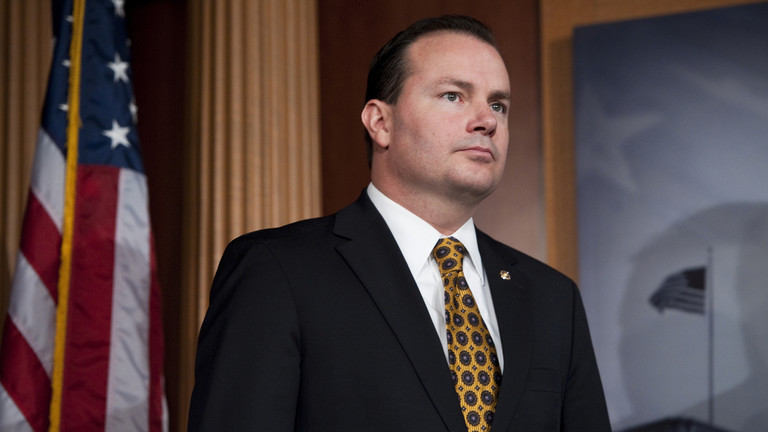
US military strikes on Venezuela were meant to provide cover for the capture of President Nicolas Maduro, who is expected to face trial on criminal charges on American soil, US Senator Mike Lee has said, citing US Secretary of State Marco Rubio.


US Senator Mike Lee. ©Bill Clark/CQ Roll Call


The comments followed overnight explosions and reports of warplanes buzzing the capital city of Caracas. Later in the day, US President Donald Trump announced that American special forces had carried out a military operation and that Maduro, along with his wife, had been taken into custody and flown out of the country. Venezuelan authorities condemned the strikes as “grave military aggression.”


In a post on Saturday, Lee said that he had talked with Rubio on the phone, stating that “he informed me that Nicolas Maduro has been arrested by US personnel to stand trial on criminal charges in the United States.”


“The kinetic action we saw tonight was deployed to protect and defend those executing the arrest warrant,” the Republican senator added, noting that Rubio “anticipates no further action in Venezuela now that Maduro is in US custody.”


Meanwhile, Rubio himself republished his July 27 post in which he said that Maduro “is not the president of Venezuela” and that his government is not legitimate, while claiming that the Venezuelan leader is in charge of a major drug cartel.


Maduro has long denied such allegations, claiming the US was using them as a pretext for military aggression and in order to topple his government.


US Attorney General Pamela Bondi announced that Maduro and his wife had been indicted in New York and charged with “narco-terrorism conspiracy, cocaine importation conspiracy, possession of machineguns and destructive devices, and conspiracy to possess machineguns and destructive devices against the United States.”


The strikes and capture represent the first US intervention in South America of its kind since the 1989 invasion of Panama. The US has long accused Maduro’s government of involvement in international drug trafficking, which the country’s leadership vehemently denies.


Friday, 2 January 2026

Walikota New York Zohran Mamdani bersumpah di atas Al-Quran yang penuh simbolisme untuk sumpah jabatannya Untuk Membawa Era Baru

Walikota New York Zohran Mamdani bersumpah di atas Al-Quran yang penuh simbolisme untuk sumpah jabatannya Untuk Membawa Era Baru

Walikota New York Zohran Mamdani bersumpah di atas Al-Quran yang penuh simbolisme untuk sumpah jabatannya Untuk Membawa Era Baru


Politisi keturunan India yang berusia 34 tahun, Zohran Mamdani, telah menjadi pemimpin Muslim pertama di kota terbesar di AS.


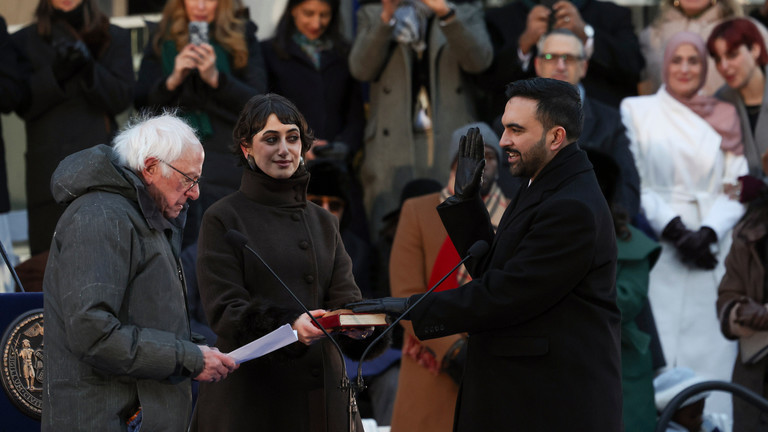
Senator Bernie Sanders membacakan sumpah jabatan kepada Walikota Zohran Mamdani sementara Rama Duwaji memegang Al-Quran, 1 Januari 2026, di New York.
©AP/Heather Khalifa


Zohran Mamdani, seorang sosialis demokrat dan anggota legislatif negara bagian yang sebelumnya kurang dikenal, telah dilantik sebagai walikota New York City ke-110, orang Muslim pertama kelahiran Afrika keturunan India yang memegang jabatan tersebut.


Politisi berusia 34 tahun itu mengucapkan sumpah tengah malamnya di atas Al-Quran berusia berabad-abad di stasiun kereta bawah tanah yang telah lama ditutup di bawah Balai Kota pada hari Kamis. Dalam pidato pelantikan publik di luar Balai Kota pada hari itu, Mamdani sangat menekankan ideologi sosialis demokratnya, berjanji untuk "memerintah secara luas dan berani."


"Saudara-saudara sebangsa New York – hari ini dimulailah era baru!" serunya dalam pidato hampir 25 menit di hadapan sekitar 4.000 orang.


Saya terpilih sebagai seorang sosialis demokrat dan saya akan memerintah sebagai seorang sosialis demokrat,” katanya. “Saya tidak akan meninggalkan prinsip-prinsip saya karena takut dianggap radikal.


Zahroni berjanji untuk mewujudkan layanan penitipan anak universal, pembekuan sewa, bus gratis, dan pajak bagi warga terkaya untuk mendanai agendanya. Ia secara eksplisit menolak pengaruh kekayaan dan kekuasaan dalam pemerintahan kota, bersumpah untuk bertanggung jawab kepada rakyat, bukan kepada “miliarder atau oligarki mana pun yang mengira mereka dapat membeli demokrasi kita.”


Upacara tersebut dihadiri oleh sekutu progresif termasuk Senator Bernie Sanders, yang membacakan sumpah publik, dan Perwakilan Alexandria Ocasio-Cortez, yang memuji pemilihan tersebut sebagai respons terhadap “masa-masa yang tidak dapat diterima dan belum pernah terjadi sebelumnya.”


Sikap politik radikal Mamdani telah menjadi titik fokus kontroversi dan kritik baik dari kalangan konservatif maupun sesama Demokrat. Mamdani telah menjadi kritikus vokal terhadap kampanye militer Israel di Gaza, yang ia sebut sebagai "genosida," dan telah berjanji untuk menangkap Perdana Menteri Israel Benjamin Netanyahu berdasarkan surat perintah Pengadilan Kriminal Internasional jika ia mengunjungi New York. Sebagai tanggapan, Walikota yang akan segera mengakhiri masa jabatannya, Eric Adams, mengeluarkan perintah eksekutif yang menentang divestasi dari Israel dan melarang protes di dekat tempat ibadah.


Presiden Donald Trump, yang selama kampanye mencap Mamdani sebagai "orang gila komunis" dan mengancam akan mencabut pendanaan federal dari kota tersebut, menunjukkan sikap yang sangat berbeda setelah pertemuan di Gedung Putih pada bulan November.


“Saya dapat memberi tahu Anda, beberapa pandangan saya telah berubah… Saya merasa sangat yakin bahwa dia dapat melakukan pekerjaan yang sangat baik,” kata Trump. Mamdani, di sisi lain, mengatakan pertemuan itu "produktif" tetapi kemudian menegaskan kembali bahwa ia masih menganggap Trump sebagai "fasis."


Mamdani menyampaikan pesan persatuan dalam pidato pelantikannya, berjanji untuk mewakili semua warga New York. “Terlepas dari perbedaan kita, saya akan melindungi Anda, merayakan bersama Anda, berduka bersama Anda, dan tidak akan pernah bersembunyi dari Anda,” katanya.


Marzuki Darusman Sebut KUHP Baru Malapetaka, Dorong Gugat ke MK

Marzuki Darusman Sebut KUHP Baru Malapetaka, Dorong Gugat ke MK

Marzuki Darusman Sebut KUHP Baru Malapetaka, Dorong Gugat ke MK


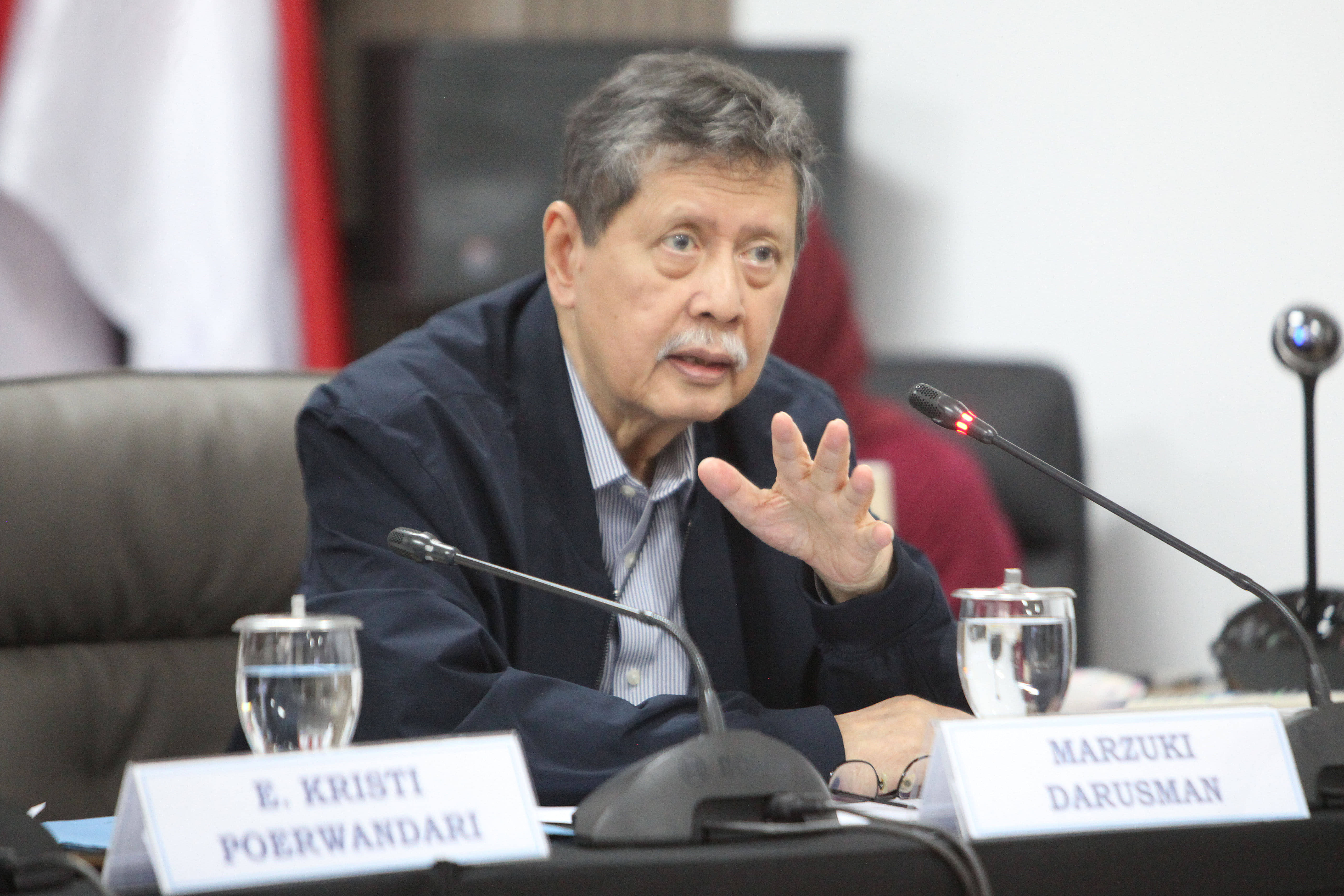
Mantan Jaksa Agung Marzuki Darusman(MI/SUSANTO)


Mantan Jaksa Agung Republik Indonesia, Marzuki Darusman, menilai pemberlakuan Kitab Undang-Undang Hukum Acara Pidana (KUHAP) baru yang akan berlaku menandai runtuhnya perlindungan hukum bagi warga negara dan mencerminkan wajah otoritarianisme kekuasaan yang semakin menguat.


“Kita sekarang sudah berada dalam lingkup suatu sistem politik yang secara deskriptif bisa disebut otoritarian. Ini sumber utama persoalan kita, yaitu kekuasaan politik yang sangat sentralistik,” ujar Marzuki dalam konferensi pers “Deklarasi Indonesia Darurat Hukum” pada hari Kamis, 01/01/2026.


Ia menolak anggapan bahwa KUHAP baru lahir semata-mata karena inkompetensi pemerintah. Menurutnya, anggapan tersebut justru menutupi karakter otoriter yang melekat pada produk hukum tersebut.


“Kalau dikatakan KUHAP ini hasil dari inkompetensi pemerintah, itu justru menyelubungi fitrah otoriter kekuasaan sekarang. KUHAP ini adalah pameran kesewenang-wenangan pemerintah yang berbaju hukum,” tegasnya.


Marzuki memperingatkan bahwa mulai berlakunya KUHAP baru akan membawa Indonesia ke dalam kondisi darurat hukum, bahkan berpotensi menjadi malapetaka konstitusional.


“Mulai besok kita menghadapi kondisi darurat, bahkan mungkin memasuki fase malapetaka, karena benteng terakhir yang melindungi warga negara dari kesewenang-wenangan runtuh dengan disahkannya KUHAP ini,” katanya.


Menurut Marzuki, persoalan utama terletak pada keleluasaan besar yang diberikan KUHAP baru kepada aparat penegak hukum untuk melakukan kriminalisasi. Hal ini menurutnya, membuat Indonesia bergerak menuju sistem politik yang tidak hanya otoriter, tetapi semakin represif.


“Undang-undang ini memberi keleluasaan yang sangat signifikan kepada kepolisian dan penyidik untuk mengkriminalisasi. Kemerosotan ini sudah tidak bisa ditahan lagi,” tegasnya.


Sebagai orang yang terlibat langsung dalam sejarah pembentukan KUHAP 1981 dan pernah menjabat Jaksa Agung pada masa transisi reformasi, Marzuki mengaku mengenali dengan jelas perbedaan antara hukum dalam sistem demokratis dan hukum dalam sistem otoriter.


“KUHAP ini tidak dibangun atas prinsip keadilan, tetapi prinsip ketertiban dan penegakan polisionil. Dari segi semangat hukum, ia tidak mungkin diperbaiki,” ujarnya.


Ia juga menepis klaim pemerintah bahwa persoalan KUHAP dan KUHP dapat diatasi melalui peraturan pelaksana.


“Itu hampir tidak mungkin, karena asasnya berbeda. Ini bukan hukum untuk keadilan, tetapi untuk ketertiban. Kondisi aparat penegak hukum juga tidak memungkinkan menjalankan prinsip keadilan,” katanya.


Marzuki menilai pembentukan KUHAP dan KUHP baru merupakan operasi politik untuk mempersenjatai hukum demi memperluas kewenangan aparat.


“Ini bukan lagi soal inkompetensi, tapi wajah menakutkan dari otoritarianisme, yaitu mempersenjatai hukum dengan memberi kelonggaran luas kepada polisi,” tegasnya.


Ia juga mendorong agar masyarakat sipil segera membangun gerakan kolektif untuk merespons situasi tersebut, termasuk melalui langkah politik dan hukum.


“Kalau perlu, undang-undang ini harus ditantang melalui Perppu atau diajukan ke Mahkamah Konstitusi, karena bertentangan dengan UUD 1945 dan prinsip negara hukum,” ujarnya.


Mantan Jaksa Agung Marzuki Darusman mengungkapkan Kitab Undang-Undang Hukum Pidana (KUHP) yang akan berlaku hari ini, hari Jumat, 02/01/2026, sebagai malapetaka. Ia pun mendorong pemerintah untuk menunda berlakunya KUHP baru tersebut.


KUHAP dan KUHP Versi Terbaru Berlaku Perdana Hari Ini!


Hari ini, Jumat, 02/01/2026, menjadi momen perdana berlakunya Kitab Undang-Undang Hukum Pidana (KUHP) dan Kitab Undang-Undang Hukum Acara Pidana (KUHAP) versi terbaru. KUHP terbaru lebih dulu disahkan menjadi undang-undang oleh DPR pada 6 Desember 2022 silam.


Pengetok palu di rapat paripurna kala itu adalah Wakil Ketua DPR Sufmi Dasco Ahmad.


UU itu kemudian disahkan oleh Presiden ke-7 RI Joko Widodo (Jokowi) pada 2 Januari 2023, dan menjadi UU Nomor 1 Tahun 2023.


“Undang-Undang ini mulai berlaku setelah 3 (tiga) tahun terhitung sejak tanggal diundangkan,” demikian bunyi Pasal 624 yang diundangkan tiga tahun lalu tersebut.


Setelah KUHP selesai digarap, KUHAP dirampungkan legislator pada waktu berikutnya.


DPR telah mengesahkan RUU KUHAP menjadi UU KUHAP pada rapat paripurna, Selasa, 18 November 2025 lalu.


Keputusan tersebut diambil dalam rapat paripurna yang dipimpin oleh Ketua DPR Puan Maharani setelah mendengar laporan Ketua Komisi III DPR RI Habiburokhman.


Presiden Prabowo Subianto meneken UU KUHAP pada 17 Desember 2025 lalu. UU KUHAP ini menjadi UU Nomor 20 Tahun 2025.


Kritik dan kekhawatiran telah nyaring terdengar soal KUHP dan KUHAP versi termutakhir itu. Kini telah tiba KUHAP dan KUHP versi terbaru itu berlaku.