Wednesday, 31 December 2025

Yemen strike shows depth of distrust between Saudi Arabia and UAE

Yemen strike shows depth of distrust between Saudi Arabia and UAE

Yemen strike shows depth of distrust between Saudi Arabia and UAE


The withdrawal of Emirati forces from Yemen following a Saudi airstrike may help defuse a confrontation between the UAE and Saudi Arabia, but the incident has exposed simmering distrust between two Gulf oil powers with long-running differences.


The airstrike by a Saudi-led coalition early on Tuesday on the southern Yemeni port of Mukalla was followed by calls on all UAE forces to leave Yemen, and a statement from Riyadh that its national security was a red line.


The UAE said it was surprised by the strike, shortly before announcing that it was pulling its remaining forces from Yemen for their safety.


The crisis, precipitated by the surprise advance of UAE-backed separatists through southern Yemen in early December, brings to the surface years of divisions between the two Gulf heavyweights on everything from oil quotas to geopolitical influence.


A Gulf source familiar with Saudi thinking told Reuters that the escalation had been triggered by a misperception resulting from talks in Washington in November between Saudi Crown Prince Mohammed bin Salman and U.S. President Donald Trump about the war in Sudan.


High-level talks including phone calls between Saudi Arabia and the UAE had taken place since December though they had not yet yielded results on the ground, the source said.


Any further conflagration between Saudi Arabia and the UAE would bode ill for the financially powerful Gulf, which prides itself on being an island of stability in a turbulent Middle East. Disagreements between Saudi Arabia and the UAE could hamper consensus on oil output decisions. The two are preparing for a virtual meeting with other OPEC+ members on Sunday.


"Relations between the two states are never easy, but the friction does appear to be at its most intense for years," said Neil Quilliam, associate fellow at think tank Chatham House.


Following their sudden advance in early December, the UAE-backed Southern Transitional Council (STC) forces now hold large swathes of land in Yemen, including in the strategically important Hadramout province.


The STC had previously been an important part of the coalition fighting alongside the Saudi-backed, internationally-recognized government against the Iran-aligned Houthi movement, which holds Yemen's capital Sanaa and the heavily populated northwest.


Their sweep through the south brought the STC within reach of Yemen's border with Saudi Arabia, in an area to which many prominent Saudis trace their origins, lending it cultural and historical significance for them.


It also put Saudi Arabia and the UAE on opposing sides of a smouldering civil war that erupted in Yemen in 2014.


Both Saudi Arabia and the UAE have publicly said they are in talks with Yemeni groups to try and bring the situation under control, but the coalition has now carried out airstrikes in the province twice in the last few days.


A person gestures towards smoke rising in the aftermath of a Saudi-led coalition airstrike, which targeted what it described as foreign military support to UAE-backed southern separatists, in Yemen's southern port of Mukalla, in this screengrab from a handout video obtained by Reuters on December 30, 2025. Aden al-Mustakillah TV/Handout via REUTERS


The STC has been rejecting calls by the Saudi coalition for its forces to withdraw from the areas it seized, saying it will continue securing Hadramout and Mahra province to its east.


In a statement on the strike in Mukalla, the UAE said it had tried to de-escalate since the STC's advance and denied being behind any operations that would undermine Saudi security or target its borders.


Divergence on Sudan


"Both countries like to play down friction in the relationship and argue that competition amongst states is a normal state of affairs," said Quilliam. "But the intensity of the competition has certainly sharpened in the past year and is playing out in multiple theatres."


One such place is Sudan, a country engulfed in civil war and one of the world's worst humanitarian crises since April 2023.


The Quad, which groups Saudi Arabia, Egypt, the U.S. and the UAE, has led diplomacy on the conflict, but the war has raged on.


Sudan is a sensitive issue for the UAE. U.N. experts and members of the U.S. Congress have accused the country of sponsoring Sudan's paramilitary Rapid Support Forces (RSF), who are fighting the Sudanese army. The UAE denies backing either side.


Trump and the Saudi Crown Prince discussed Sudan at the November meeting in Washington.


The Gulf source said the UAE leadership was angered as they had been "misinformed" that during the November meeting the Saudi Crown Prince had not just asked for further sanctions against the RSF, but also for more direct sanctions against the UAE for its alleged support to the group.


The misperception led to the escalation in Yemen, the source said.


The UAE foreign ministry did not confirm or deny this account and referred Reuters to an earlier statement issued on Friday in which the UAE had welcomed Saudi Arabia's efforts to support security and stability in Yemen and said it also remained committed to backing stability in the country.


Past Instability


Anwar Gargash, diplomatic advisor to the UAE president, said on Saturday in a post on X that dialogue and political solutions that preserve friendships and alliances were essential in what he called a "critical stage". He did not clearly reference Yemen or Saudi Arabia in his remarks.


The White House did not immediately respond to a request for comment when asked about the issue.


The Gulf has witnessed instability in the past.


In 2017, Saudi Arabia, UAE, Bahrain, Oman and Egypt choked off Qatar's economy with a boycott, accusing it of backing terrorists, a charge Doha denied.


The latest flare-up appears unlikely to spur a repeat of the Qatar crisis. "We do have differences over Yemen 100%, and the difference has gone to a higher level with current escalation," said Abdulkhaleq Abdullah, an Emirati academic. "Allies clash ... But they mend their differences and build on what they have in common."


Saudi Arabia Strikes Yemen as UAE Forces Asked to Leave


Earlier on Tuesday, Saudi Arabia said its national security was a "red line" and backed demands that United Arab Emirates forces leave Yemen within 24 hours, marking Riyadh's strongest statement yet against its Gulf allies amid rising tensions in the war-torn country.


The warning came hours after a Saudi-led coalition carried out an airstrike on the southern Yemeni port of Mukalla, targeting what it described as unauthorized foreign military support for UAE-backed southern separatist forces.


Yemen’s Saudi-backed presidential council head, Rashad al-Alimi, ordered Emirati forces to withdraw and announced the cancellation of a defense pact with the UAE, accusing Abu Dhabi of fueling internal conflict through its support for the Southern Transitional Council (STC), a separatist group seeking autonomy in southern Yemen.


President of the UAE Sheikh Mohammed bin Zayed Al Nahyan, and Yemeni Prime Minister Muin Abdulmelik meet as part of the World Government Summit in Dubai, United Arab Emirates on February 13, 2023 - Photo by Anadolu Images


“It has been definitively confirmed that the United Arab Emirates pressured and directed the STC to undermine state authority through military escalation,” Alimi said in a televised address, according to Yemen’s state news agency.


Saudi Arabia urged the UAE to comply with the withdrawal demand. The UAE’s foreign ministry did not immediately respond to requests for comment.


Gulf stock markets fell following the flare-up, reflecting investor concern over rising tensions between the two longtime allies.


Mukalla strike and separatist advance


The Saudi-led coalition said the airstrike on Mukalla port caused no casualties or collateral damage. Two sources told Reuters the strike targeted a dock where cargo from two vessels had been unloaded.


Coalition officials said the ships arrived over the weekend from the UAE port of Fujairah without authorization, disabled their tracking systems, and unloaded weapons and combat vehicles intended to support the STC.


Yemeni state television aired footage showing black smoke rising from the port and burned vehicles in the area.


The STC, backed by the UAE, has recently made significant advances in southern Yemen, breaking years of military stalemate and seizing control of large areas, including parts of the strategic Hadramout province, which borders Saudi Arabia.


Saudi Arabia had warned the STC against further military moves in Hadramout and demanded a withdrawal, a call the group rejected.


Deepening rift among allies


The UAE was part of the Saudi-led coalition fighting Yemen’s Iran-aligned Houthi movement from 2015. Although Abu Dhabi began reducing its troop presence in 2019, it has continued to wield influence through local allied forces, including the STC.


The recent STC offensive has brought Saudi Arabia and the UAE closer to direct confrontation, exposing fractures within the coalition that once fought the Houthis together.


In response to the escalation, Alimi imposed a 72-hour no-fly zone and a sea and land blockade on ports and crossings, with limited exemptions authorized by the coalition.


The STC’s leadership in Hadramout rejected the withdrawal demand, calling the Mukalla strike “a blatant attack on Hadramout and its people,” and described the UAE as an ally that should not be abandoned.


Yemen’s internationally recognized government accused the STC of staging an armed rebellion and serving Houthi interests, while praising Saudi Arabia for acting to prevent eastern Yemen from descending into chaos.


The Houthis continue to control northern Yemen, including the capital Sanaa, while the conflict remains fragmented among rival factions despite years of international efforts to end the war.







Tuesday, 30 December 2025

Response to Kiev’s attack on Putin’s residence will not be diplomatic – Moscow

Response to Kiev’s attack on Putin’s residence will not be diplomatic – Moscow

Response to Kiev’s attack on Putin’s residence will not be diplomatic – Moscow


Russian Foreign Ministry spokeswoman Maria Zakharova. ©Sputnik/Artyom Pryakhin


Russia’s response to a failed Ukrainian drone attack on President Vladimir Putin’s state residence will not be diplomatic, Foreign Ministry spokeswoman Maria Zakharova warned on Monday.


Earlier in the day, Foreign Minister Sergey Lavrov stated that on the night of December 28-29, “the Kiev regime launched a terrorist attack using 91 long-range strike unmanned aerial vehicles on the state residence of the president of the Russian Federation in Novgorod Region.”


He noted that all 91 UAVs were intercepted, with no casualties or material damage reported.


Lavrov noted that while Moscow remains committed to the US-mediated peace process, “Russia’s negotiating position will be revised” in light of Ukraine’s “reckless actions.”


“Targets for retaliatory strikes and the time for their implementation by the Russian Armed Forces have been determined,” the minister warned.


“The answers will not be diplomatic. Let them not get their hopes up,” Zakharova told Russian media late Monday, calling the attempted attack unprecedented. “The unprecedented nature of this attack lies in the fact that it was carried out during the negotiations in the United States… At the very moment, when plans are being discussed, this, excuse me, bloody, rabid, terrorist scum, is undermining peace efforts.”


Kremlin foreign policy aide Yury Ushakov told Russian media that during a phone conversation with Putin on Monday, US President Donald Trump said he was “shocked by this news and expressed outrage, stating that he could not have imagined such crazy actions on the part of Kiev.”


Ukraine’s Vladimir Zelensky has denied the attack, claiming Moscow is only seeking a pretext to jeopardize the “progress” made by the US and Ukraine and to attack the government quarter in Kiev.


Lavrov responds to failed Ukrainian attack on Putin’s residence - Video


Russian Foreign Minister Sergey Lavrov. © Sputnik/Sergey Guneev Russia will revise its “negotiating position” in the Ukraine talks in light of an attempted drone attack on President Vladimir Putin’s state residence, Foreign Minister Sergey Lavrov has stated.


Russian Foreign Minister Sergey Lavrov. ©Sputnik/Sergey Guneev


In a statement on Monday, the diplomat said that on the night of December 28-29, “the Kiev regime launched a terrorist attack, using 91 long-range strike unmanned aerial vehicles on the state residence of the president of the Russian Federation in Novgorod Region.” According to Lavrov, all 91 UAVs were intercepted, with no reports of casualties or material damage on the ground.


Lavrov emphasized that the failed attack on the president’s residence came at a time when Russian and US representatives were engaged in “intensive negotiations.”


The minister noted that while Moscow will not withdraw from the US-mediated talks aimed at settling the Ukraine conflict, “Russia’s negotiating position will be revised” in light of Ukraine’s “reckless actions.”


“Targets for retaliatory strikes and the time for their implementation by the Russian Armed Forces have been determined,” Lavrov concluded.


Russia's claim Ukraine attacked Putin's home 'doesn't make any sense', experts say


A Ukrainian drone strike on Russian President Vladimir Putin's home would be "technically" possible but strategically "stupid", experts have told the ABC.


Moscow alleged on Monday, local time, that Kyiv launched an attack on Mr Putin's state residence in Russia's Novgorod region.


Russia on Monday promised to retaliate against Ukraine after it said nearly 100 drones had targeted one of President Vladimir Putin's residences, likely throwing a wrench into President Donald Trump’s efforts to end the nearly four-year war.


"Such reckless actions will not go unanswered. The targets for retaliatory strikes and the timing of their implementation by the Russian armed forces have been determined," Russian Foreign Minister Sergei Lavrov said without offering details of the alleged attacks in the region of Novgorod.


Soon after, Ukrainian President Volodymyr Zelenskyy called the claims a lie aimed at jeopardizing negotiations. Russia would most likely use the alleged attack to launch strikes at government buildings in Kyiv, the capital, he added.


Trump later told reporters that he "just heard" about the attack alleged by Russia.


“That would be too bad. That would not be good,” he said ahead of his meeting with Israeli Prime Minister Benjamin Netanyahu.


Trump then said that Putin had informed him of the alleged attack during a phone call this morning.


“It’s one thing to be offensive,” he said. “It’s another thing to attack his house. It’s not the right time to do any of that.”


On Sunday, Trump was unusually optimistic about the peace process as he stood next to Zelenskyy at his Mar-a-Lago property in Florida. The Kremlin on Monday agreed with Trump’s assessment that talks to end its war were in the final stage even as it stuck to its hard-line territorial demands.


After nearly three hours behind closed doors Sunday, Trump and Zelenskyy emerged to say they were “very close” to a deal and “90%” of the way there. But it’s those remaining “one or two very thorny issues” that will decide whether an agreement can be found between Kyiv and Moscow, Trump said.


Answering questions from reporters in a WhatsApp chat Monday, Zelenskyy outlined one key area where there does seem to have been progress.


The Ukrainian leader said Trump was now offering Kyiv legally binding security guarantees that would last for 15 years, though he had asked for them to remain in place for up to half a century.


“I told him that we have been at war for almost 15 years, and therefore we would very much like the guarantees to be longer,” Zelenskyy said, referring to Russia’s annexation of the Crimean Peninsula in 2014 and backing of pro-Russian separatists in Ukraine’s east before a full-scale invasion in 2022.


He said Trump indicated he would consider longer guarantees, adding that they include how a peace deal would be monitored as well as the “presence” of partners.


But while Ukraine appeared positive about this offer to guarantee its security against future Russian aggression, few details were made public and it was unclear how Russia would view the proposal.


Zelenskyy also made clear that the fate of key territory remains unresolved.


Control over the eastern Donbas region and the Zaporizhzhia Nuclear Power Plant remain crucial sticking points in Trump's 20-point peace plan, a version of the original U.S. proposal that has been modified through weeks of intense diplomacy.


Ukraine still controls a chunk of Donbas and has vowed it won't give up that land, but Russia wants the whole region — a major demand that Putin has shown no desire to compromise on. The Zaporizhzhia Nuclear Power Plant, Europe’s largest, is occupied by Russia but each side wants control of it in a deal.


American negotiators have previously floated the concept of establishing a “free economic zone” in Donbas, but Zelenskyy said Monday there is “no detailed concept” of how that would work yet, and that Ukrainian society would need to be consulted on any such agreement.


In fact, he said the whole 20-point peace plan should be put to a referendum in Ukraine, which he said would require a ceasefire of at least 60 days.


Moscow has ruled out agreeing to any temporary ceasefires, insisting that it was only interested in a permanent peace agreement — a position that Trump said Sunday he understood.


Before Trump met with Zelenskyy, he spoke on the phone with Putin for over two hours.


Trump said he believed the Russian president was serious about peace, but Zelenskyy was skeptical. “It is important that the actions and words of the Russian leader coincide,” he said Monday.


For its part the Kremlin agreed with Trump’s assessment that peace in Ukraine was closer.


But spokesman Dmitry Peskov doubled down on Moscow’s requirement that Ukraine withdraw fully from Donbas. Putin later received battlefield updates from his generals at a televised meeting and boasted his forces were in position to “liberate” the entire Donbas.


Saturday, 27 December 2025

No turning point for Ukraine: The frontline reality Western media won’t show

No turning point for Ukraine: The frontline reality Western media won’t show

No turning point for Ukraine: The frontline reality Western media won’t show


From stalled urban battles to collapsing strongholds, developments in December highlight Russia’s growing operational advantage


By late December, the gap between political statements and battlefield realities has grown harder to ignore. Despite localized fighting and temporary slowdowns, the Russian Army continues to press forward along key sectors of the front, gradually eroding Ukrainian defenses and dictating the pace of operations.


During a press conference on December 19, Russian President Vladimir Putin succinctly outlined the situation at the front: since March, when Kursk Region was cleared of enemy forces, the full strategic initiative on the battlefield has been in the hands of the Russian Army. This means that Russian forces are advancing along the entire front line.


A counter-question was immediately posed: what about Kupyansk? The Ukrainian military claims to have recaptured the city, and Vladimir Zelensky has reportedly even visited it. So, let’s start our overview there.


Kupyansk


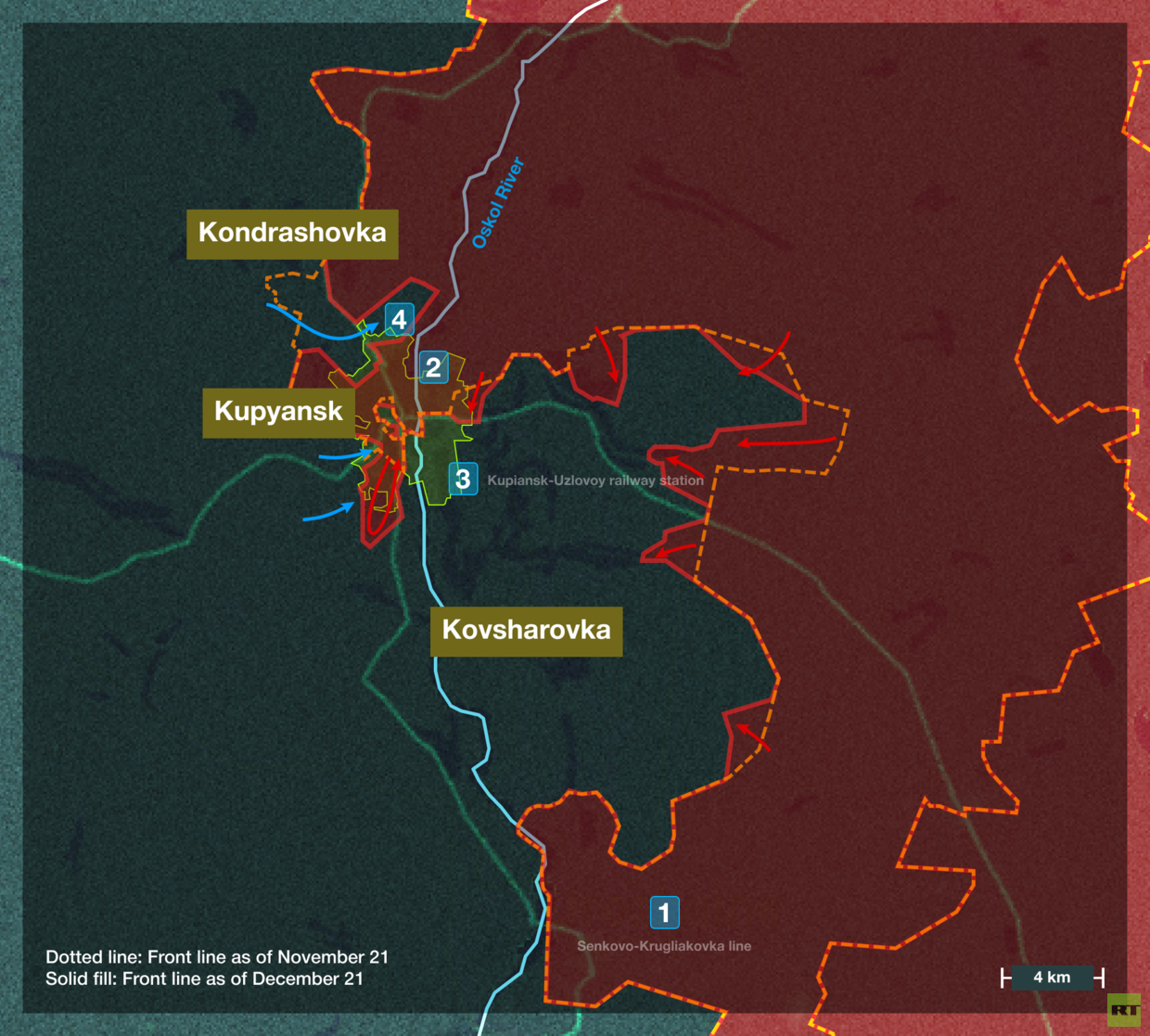
The Russian Army faces challenges in Kupyansk because the ‘West’ group of forces has failed to encircle the city from three sides before engaging in battles. Kupyansk is divided from north to south by the Oskol River; to encircle the city, the Russian Army needs to establish reliable and well-protected crossings north and south of the city, and also advance from the east.


Russian forces were able to establish, fortify, and expand a foothold north of Kupyansk, in the Kondrashovka area; however, they didn’t establish a foothold south of the city, along the Senkovo-Krugliakovka line (1 on map). However, this summer, the Ukrainian defenses in Kupyansk weakened significantly, prompting the Russian command to decide to enter the city from the north.


©RT/Sergey Poletaev based on data from Lostarmor.Ru


Until mid-October, battles for Kupyansk progressed fairly well. To reach the city, it was said that troops would have to navigate through a heating pipeline at the bottom of the river (2) and then continue on foot or crawl their way forward. Logistics were complicated and relied on personal delivery or drones. But the risk was worth taking.


By mid-October, the central part of Kupyansk, located on the right bank of the river, was fully under Russian control. Due to logistical challenges, it was not possible to deploy large troop formations in Kupyansk; estimates suggest that no more than 150-200 Russian soldiers were present there at a time.


However, the left-bank portion of the city, where a major railway hub is located, remains under Ukrainian control (3); up to 3,500 soldiers are operationally encircled there.


Ukrainian forces recognized the weak points of the Russian positions on the right bank and launched a local counteroffensive. In late October, Ukrainian forces reinforced their troops and attempted to cut off Russian supply lines between Kupyansk and Kondrashovka (4). As a result, the area north of the city has become a gray zone. Supplies are mainly delivered by drones, despite the fact that the supply routes haven’t been physically cut off.


However, the pace of combat in the city has noticeably slowed, forcing the command of the ‘West’ group of forces to revert to a more conservative approach, shifting the focus to the left bank. The goal is to liberate the area, capture the Kupyansk-Uzlovoy railway station, and establish a physical link with the right bank within the city itself.


Could this local failure of the Russian Army have a noticeable impact on the future course of the conflict? Not really. Kupyansk will only gain strategic importance if the front shifts back by 25-30km, beyond the reach of FPV drones. Only then can the railway be utilized for supplying the army, which would ease logistics in this remote corner of the front.


Liman


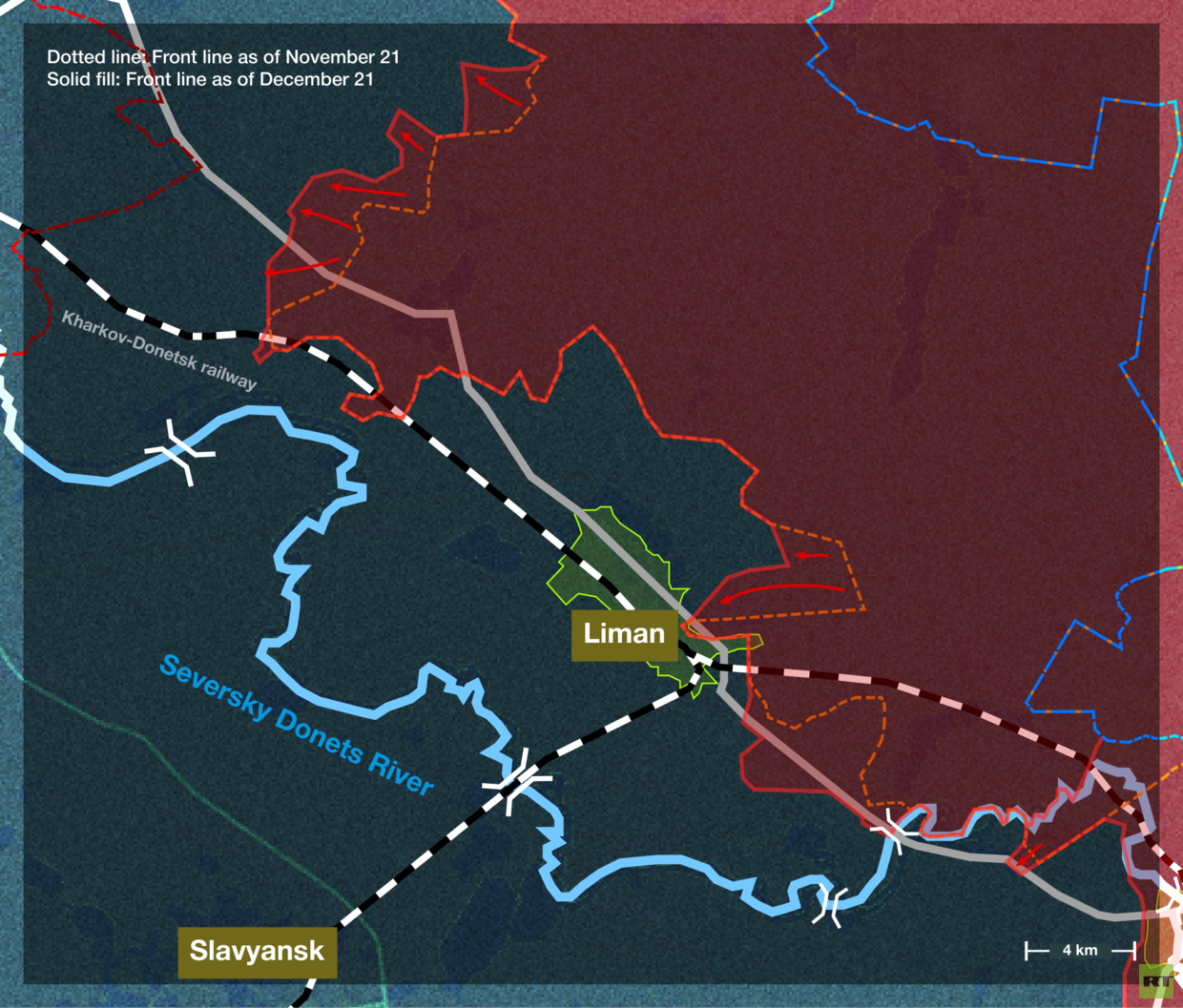
In addition to Kupyansk, the ‘West’ group of forces is advancing towards Liman, the second major city north of the Seversky Donets River. Russian forces abandoned Liman during Ukraine’s counteroffensive in 2022. Liman needs to be recaptured by Russian troops not just because it is located in Russia’s Donetsk People’s Republic, but also in order to secure the northern flank for potential future battles over Slavyansk.


In the past month, the eastern flank of the city has been fully isolated, and a 7km stretch of the road between Liman and Seversk has been severed. The partial encirclement on the western flank has expanded, and intense fighting continues within the city itself.


© RT / Sergey Poletaev based on data from Lostarmor.Ru


All of this signifies that the Ukrainian garrison in Liman has entered a phase of exhaustion. If it weren’t for orders to hold the city at all costs, Ukrainian forces would likely have retreated long ago, as supplying the city across the river is quite challenging.

Seversk


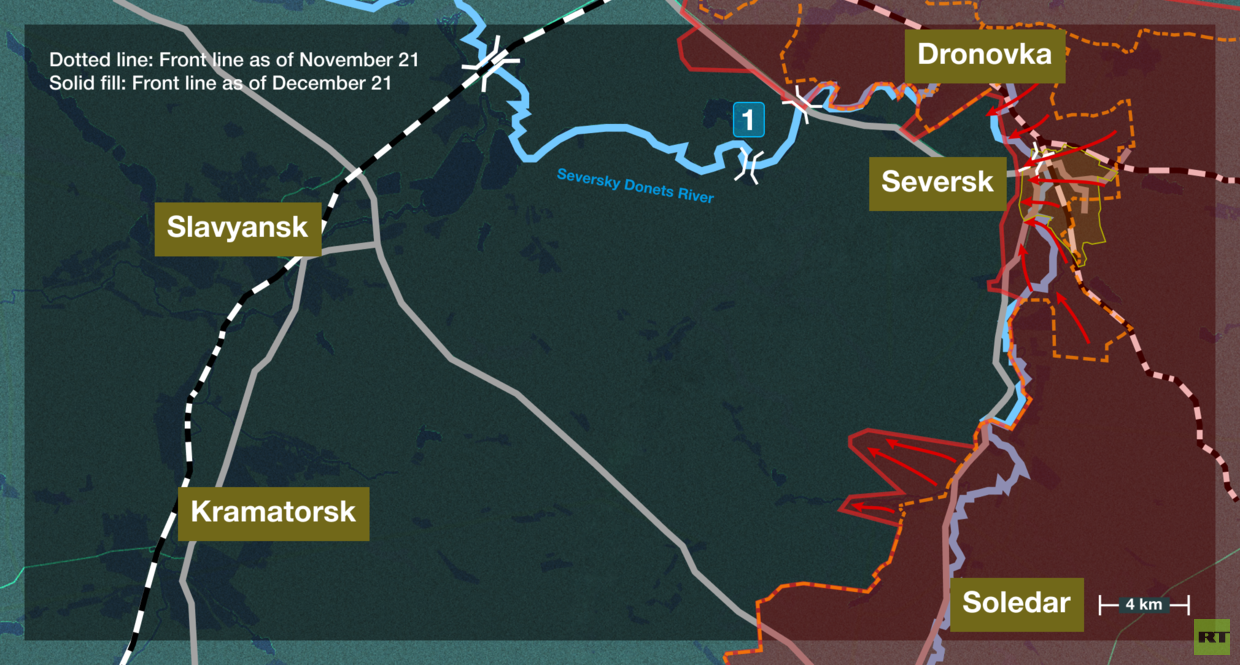
On December 11, Seversk was officially liberated. The city was captured in less than a month, which is remarkably quick by the standards of the current conflict. Once the Russian army took control of both main routes leading into the city at the end of November, its fate was sealed.


The Ukrainian garrison here could have held out longer, as for example, in Pokrovsk (Krasnoarmeysk). However, unlike in other ‘strongholds’, the Ukrainian forces chose not to launch suicidal counterattacks here and wisely left the area in a timely manner.


© RT / Sergey Poletaev based on data from Lostarmor.Ru


The capture of Seversk paves the way to Ukrainian forces’ major stronghold: the Slavyansk-Kramatorsk urban agglomeration. If Russian forces manage to cross the river west of Seversk (1 on map) and establish a foothold on higher ground, Ukraine would have to abandon another defensive line and retreat towards Slavyansk.


Such a maneuver is quite possible. For example, it was the crossing of the Seversky Donets River near the railway bridge in the area of Dronovka that allowed the Russians to cut off one of the routes to Seversk, leading to success in battles for the city.


Pokrovsk – Mirnograd


The Pokrovsk-Mirnograd urban agglomeration was the second most populous area remaining under Ukrainian control in Donbass. Moreover, open steppes stretch for nearly 100km west of Pokrovsk, so beyond the city there are no major settlements where Ukrainian forces can establish durable defense.


Fighting in this area has continued since spring; we’ve covered it in detail before.


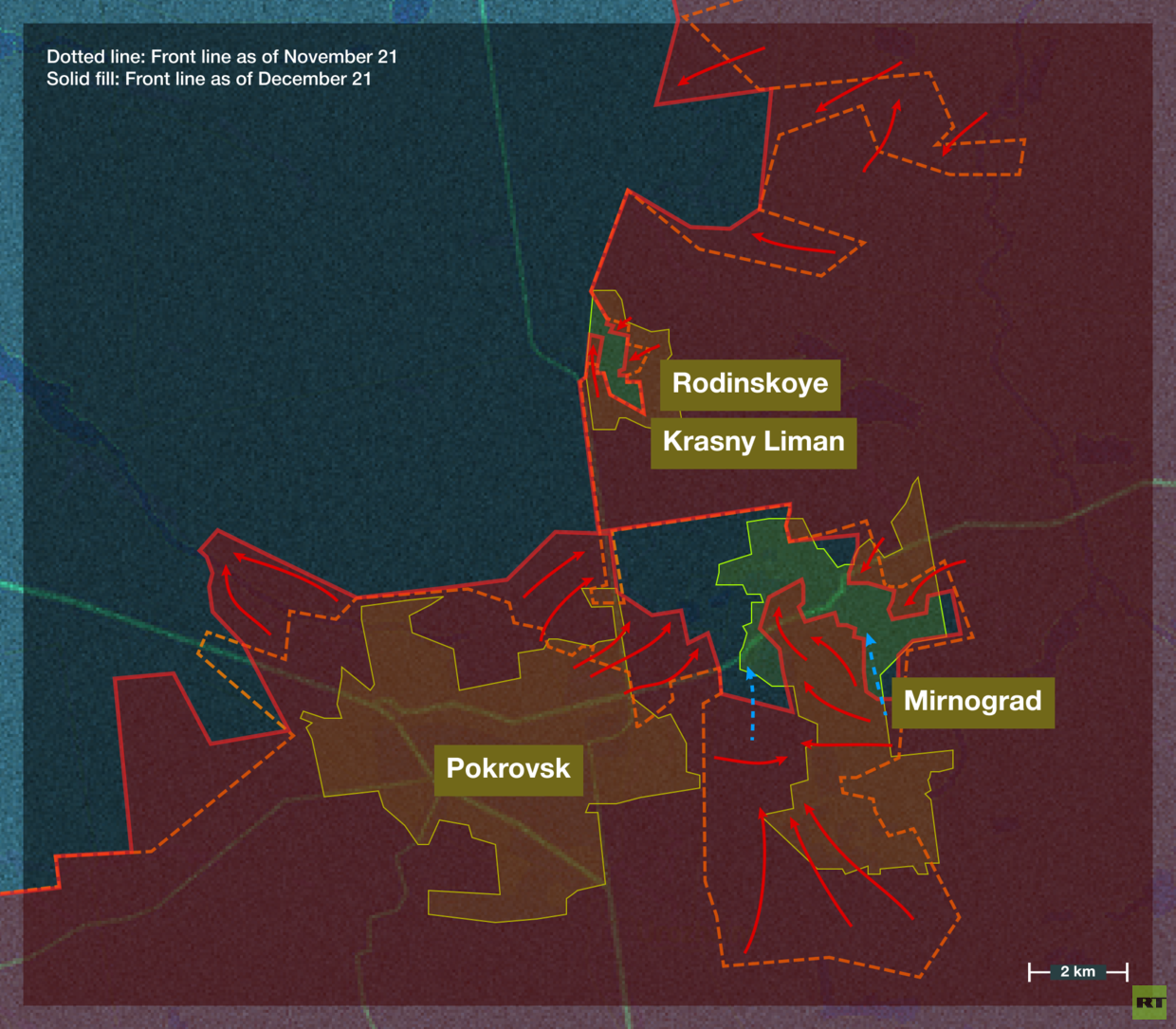
In the past month, two key events have occurred. Firstly, the Ukrainian counteroffensive has failed. The Ukrainian attempt to break through the encirclement of Mirnograd from the north via Rodninskoye hasn’t produced any result, and Rodninskoye has partially come back under Russian control.


Secondly, by the end of November, the Russian Army completely liberated Pokrovsk. A tight physical encirclement was formed (for the first time since battles for Mariupol), leaving the garrison in Mirnograd trapped. Hundreds of Ukrainian soldiers surrendered, a few dozen managed to escape through the fields; the fate of the rest is clear.


© RT / Sergey Poletaev based on data from Lostarmor.Ru


According to reports, as of December 25, 90-95% of the urban area of Mirnograd had been cleared. Due to our conservative reporting standards, the map shows a smaller area of control – it is based on video evidence, which usually lags behind compared to the situation on the ground.


The fates of Pokrovsk and Mirnograd have been sealed. It’s likely that official announcements of their liberation will come before the end of the year.


Gulaipole


In the past several months, the greatest advance of the Russian Army has been noted between Gulaipole in Zaporozhye Region and Pokrovskoye in Dnepropetrovsk Region. This front is crucial for two reasons: first, it runs along one of Ukraine’s major defensive lines, rendering it largely ineffective.


Second, Russian forces are advancing across open steppes and favorable terrain toward Zaporozhye, and as we can see, the Ukrainian military is currently unable to stop them, as it struggles to establish a stable front there.


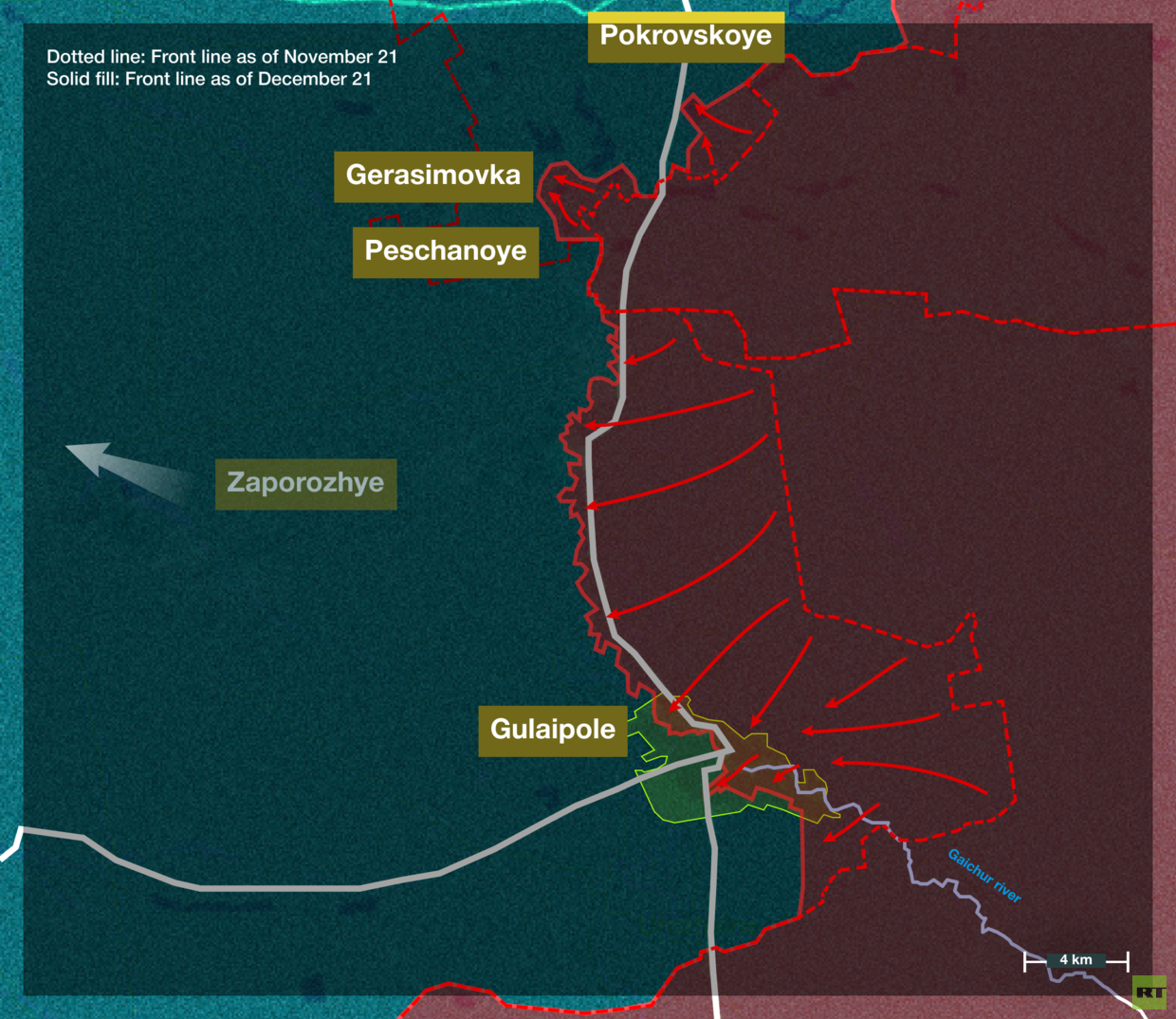
Over the past month, Russian forces have taken full control over the eastern bank of the Gaichur river without fighting; troops advanced up to 15km along a 30km front.


© RT / Sergey Poletaev based on data from Lostarmor.Ru


Russian troops also established a foothold across the river on the northern flank of the offensive, and captured Peschanoye and Gerasimovka without major resistance.


Ukrainian forces managed to establish a certain defense only in the city of Gulaipole. The Russian Army couldn’t capture it right away; only the part of the city on the eastern bank of the Gaichur river was liberated without battles.


However, Russian troops managed to cross the river and battles are now underway in the central districts of the city. Ukrainian reinforcements sent in to defend the city found themselves operationally encircled, as a 30km stretch of the only road leading into the city is under intense fire control


.
By Sergey Poletaev, information analyst and publicist, co-founder and editor of the Vatfor project


Thursday, 25 December 2025

Dolar AS Jatuh Dititik Nadir Rekor Terburuk Dalam 20 Tahun Terakhir

Dolar AS Jatuh Dititik Nadir Rekor Terburuk Dalam 20 Tahun Terakhir

Dolar AS Jatuh Dititik Nadir Rekor Terburuk Dalam 20 Tahun Terakhir


Dolar Amerika Serikat (AS) sepanjang tahun ini tidak berjalan mulus. Kini Greenback* menghadapi tekanan kuat seiring tren pelemahan indeks dolar AS (DXY), yang mengukur kekuatan dolar terhadap enam mata uang utama dunia.


Berdasarkan data Refinitiv, indeks dolar AS di awal tahun masih berada di level 108,526. Namun seiring dalam perjalanannya, DXY terus tertekan hingga pada perdagangan pada hari Rabu, 24/12/2025, dan sempat menyentuh di level 97,749.


Hasil perhitungan secara kumulatif, DXY tercatat melemah 9,93% sepanjang tahun ini. Penurunan tersebut menjadi yang terdalam secara tahunan sejak 2003, atau lebih dari dua dekade terakhir, ketika pada tahun tersebut indeks dolar AS anjlok hingga 14,6% dalam setahun.


Pelemahan dolar AS terjadi seiring dengan meningkatnya keyakinan investor bahwa bank sentral AS (The Federal Reserve/The Fed) masih memiliki ruang untuk memangkas suku bunga lebih lanjut ke depan.


Meski data ekonomi Amerika Serikat, termasuk pertumbuhan produk domestik bruto (PDB), tercatat solid, hal tersebut belum mampu mengubah ekspektasi pasar terhadap arah kebijakan suku bunga. Investor masih memperkirakan adanya sekitar dua kali pemangkasan suku bunga lanjutan.


Di pasar global, pelemahan dolar AS tercermin dari pergerakannya terhadap mata uang negara-negara dengan ekonomi besar dunia. Sepanjang tahun berjalan, greenback tercatat melemah dan kalah bersaing melawan sejumlah mata uang, baik dari Eropa maupun Asia.


Dolar Terpuruk dari Swiss Franc


Melansir data Refinitiv, dolar AS mencatat pelemahan paling dalam terhadap Swiss franc sepanjang tahun ini. Pada awal tahun, nilai tukar berada di level CHF 0,9072/US$, namun hingga perdagangan oada hari Rabu, 24/12/2025, bergerak ke posisi CHF 0,7868/US$.


Secara kumulatif, dolar AS tercatat melemah 13,27% terhadap franc Swiss.


Dolar Keok dari Euro


Tekanan juga datang dari mata uang kawasan Eropa. Sepanjang tahun berjalan, dolar AS tertekan terhadap euro. Nilai tukar bergerak dari EUR 0,9657/US$ di awal tahun menjadi EUR 0,8475/US$ pada akhir periode, atau setara dengan pelemahan sebesar 12,24% secara tahunan bagi greenback.


Dolar Tertekan oleh Yen Jepang


Meski pergerakannya relatif lebih terbatas, dolar AS tetap mencatat pelemahan terhadap yen Jepang. Nilai tukar JPY 157,18/US$ di awal tahun bergeser ke JPY 155,74/US% yang mencerminkan pelemahan dolar AS sebesar 0,92% secara kumulatif.


Dolar Kalah dari Yuan China


Dari Asia, yuan China juga mencatat kinerja lebih kuat dibanding dolar AS. Nilai tukar bergerak dari CNY 7,2996/US$ pada awal tahun menjadi CNY 7,0131/US$ di akhir periode perdagangan, yang berarti dolar AS melemah sekitar 3,92% sepanjang 2025.


Note:


Greenback adalah salah satu mata uang yang paling banyak diperdagangkan di dunia, dan merupakan mata uang cadangan utama


Updates - Korban Bencana Sumatera 1.129 Meninggal 174 Hilang

Updates - Korban Bencana Sumatera 1.129 Meninggal 174 Hilang

Updates - Korban Bencana Sumatera 1.129 Meninggal 174 Hilang


Korban jiwa bencana alam di Sumatra Utara. ANTARA/HO-Pusdalops Sumut


Jumlah terbaru korban terdampak banjir bandang hingga tanah longsor di Aceh, Sumatera Barat, dan Sumatera Utara, meninggal dunia 1.129 dan korban hilang menjadi 174.


Badan Nasional Penanggulangan Bencana (BNPB) mencatat ada penambahan 17 korban meninggal dunia akibat bencana alam banjir dan longsor di Aceh, Sumatera Utara dan Sumatera Barat.


"Per hari ini, terdapat penambahan daftar korban meninggal dunia sebanyak 17 jiwa, sehingga total korban jiwa secara keseluruhan kini mencapai 1.129 orang," ujar Abdul dalam konferensi pers yang digelar virtual, pada hari Rabu, 24/12/2025.


Abdul juga menyampaikan bahwa, jumlah korban hilang berkurang 2 orang. Untuk itu, jumlah korban hilang menjadi 174 jiwa. Sedangkan untuk korban mengungsi, BMPB mencatat ada 496.293 jiwa.


"Untuk status dari kabupaten/kota yang terdampak, saat ini per hari ini, 12 kabupaten/kota sudah bergeser dari status Tanggap Darurat ke status Transisi Darurat. Itu di Provinsi Aceh ada 4 kabupaten/kota, Sumatera Utara 4 kabupaten/kota, dan Sumatera Barat 4 kabupaten/kota," ungkap Abdul.


"Adapun penambahan korban jiwa di Aceh Utara 14 jiwa, Tapteng, Sibolga, dan Sumbar masing-masing 1 jiwa," sambungnya.


Sementara untuk korban hilang menjadi 174 jiwa. Dan yang mengungsi masih mencapai ratusan ribu jiwa.


"Untuk korban hilang berkurang 2 jiwa, jadi 174 jiwa. Sedangkan untuk pengungsi 496.293 jiwa," tuturnya.


Dalam jumpa pers ini, Muhari juga menjelaskan proses evakuasi korban dan pembangunan jalan dan jembatan yang putus terus dilakukan.