Friday, 9 August 2024

Militants of Zelensky's regime hunt Russian war correspondents — Russian diplomat

Militants of Zelensky's regime hunt Russian war correspondents — Russian diplomat

Militants of Zelensky's regime hunt Russian war correspondents — Russian diplomat


Russian Foreign Ministry Spokeswoman Maria Zakharova
©Alexander Demianchuk/TASS


Militants of Ukrainian leader Vladimir Zelensky's regime are conducting a real hunt for Russian media representatives and war correspondents, Russian Foreign Ministry Spokeswoman Maria Zakharova said.


"Militants of Zelensky's terrorist regime are conducting a real hunt for Russian media representatives and war correspondents whose reports are documentary evidence of atrocities committed by Ukrainian armed formations against civilians," the diplomat said in connection with the attempted assassination of war correspondent Yevgeny Poddubny.


According to Zakharova, with the tacit consent of the West and human rights structures under its control, "the Kiev regime has indeed declared unarmed media workers its priority targets, while openly boasting about it." "Under the 1949 Geneva Conventions and Additional Protocol I, journalists are equal to civilians and are protected from attack. Failure to comply with these norms constitutes a serious violation of international humanitarian law by Zelensky's regime," she added.


"We demand from the relevant international organizations an immediate reaction and a strong condemnation of the terrorist activities of the Bandera regime," the spokeswoman emphasized.


Zakharova pointed out that the perpetrators of the attempt on the life of military correspondent Poddubny will inevitably be punished. "As we’ve repeatedly emphasized, the Russian Investigative Committee thoroughly records all crimes of the Kiev clique. Based on the collected evidence, Russian courts convict neo-Nazis who committed grave crimes against peaceful citizens, including against media workers. We are confident that those responsible for the attempt on the life of the Russian journalist will inevitably be punished," the spokeswoman concluded.


On August 7, Poddubny received multiple wounds in the Kursk Region near the border with Ukraine, where battles with Ukrainian armed formations are taking place. Doctors assessed his condition as serious but stable. On August 8, the journalist was taken to Moscow for treatment.


‘I’m afraid of dying’: How and why Ukrainian men hide from military service


Ukraine’s general mobilization – announced in the spring of 2022 – changed the lives of thousands of military-age men. There are questions about the motivation levels of forced conscripts, yet Kiev desperately needs more troops in the combat zone. In an attempt to escape tightening mobilization laws, Ukrainian men are resorting to increasingly desperate measures: from donning strap-on breasts to risking their lives by crossing the border. Here, we look at the steps the Kiev authorities are taking to hunt down draft dodgers, and the risks many are willing to take to avoid being caught.


Tightening what looks more and more like a noose


After the start of Russia’s military operation in February 2022, the Ukrainian authorities imposed martial law. General mobilization followed soon afterwards. The rights of a significant part of Ukraine’s male population have been restricted ever since, including a ban on military-age men from leaving the country. However, in April of this year, the rules were further tightened, and the draft age was lowered from 27 to 25.


Moreover, a category describing people as having “limited fitness” for military service was abolished. A potential serviceman is now either “fit” or “unfit” for duty. This effectively means that the Ukrainian army is conscripting people who would be considered unfit for service in most parts of the world – such as those with HIV, chronic viral hepatitis, stage 1 hypertension, and even those with hearing problems and “neurotic mild mental disorders.”


All Ukrainian men between the ages of 18 and 60, regardless of whether they are fit for duty or exempt, must now carry a military ID. Without it, men cannot receive a passport to travel abroad. Kiev has even refused to provide consular services to Ukrainian men living outside the country. Foreign Affairs Minister Dmitry Kuleba said that men of military age who are “sitting abroad” will not receive consular services from a nation that they don’t want to defend.


All Ukrainian men must personally register at a military office. Violators face penalties ranging from 17,000 to 22,500 hryvnia ($415-$550) – which is around the same as the average monthly salary – to the confiscation of driver’s licenses. Military enlistment offices can also contact the police, who will deliver a conscript by force.


Persons exempt from mobilization include police officers, employees of the National Anti-Corruption Bureau, the State Bureau of Investigation, the Prosecutor’s Office, the State Emergency Service, MPs, ministers, judges, employees, and the owners of defense-industry enterprises.


Other exemption categories include disabled persons, fathers of many children, single parents, those with disabled children, and students.


Included in the amendments to the mobilization law is the removal of a paragraph concerning the demobilization of military personnel who have already served for 36 months.


Ukraine is resorting to such measures because it desperately needs more people in the army. This is an issue often discussed among oits leadership. Kiev believes that increased mobilization will deliver a breakthrough on the battlefield. When announcing the new measures, Vladimir Zelensky explained that the General Staff of the Armed Forces of Ukraine (AFU) and its former commander-in-chief, Valery Zaluzhny, had insisted on 450,000-500,000 more recruits.


The Ukrainian government has allowed Territorial Recruitment Centers (TRCs), the official term for military enlistment offices, to deliver summonses regardless of where a man’s military registration is. This means a summons can be served at a his place of residence, work or study, in public places, buildings, crowded areas, and at checkpoints and border crossings. Summonses can be distributed not only by military commissars but also by special “notification groups” that include those who are not subject to mobilization, local officials, the management of enterprises, and public institutions.


Crowds of draft dodgers


The Ukrainian authorities try to lure men to the front, but they do their best to hide. According to an ex-lieutenant colonel of Ukraine’s security service (SBU), Vasily Prozorov, the number of draft dodgers who have illegally left the country has significantly increased since the new law on mobilization was adopted. He says people have realized that the situation both at the front and in Ukraine is getting worse.


“The results (of the new mobilization law – RT) are best summed up by footage from the streets of Ukrainian cities. It clearly shows that things are going very, very badly with mobilization,” Prozorov told RIA Novosti, commenting on a video in which TRC employees are seen attempting to catch people on the streets.


Last fall, even TRC representative Yury Semchuk, as quoted by UNIAN, claimed that 99% of Ukrainian men are dodging the draft. According to Semchuk, the elite has fled and only “genetic slaves” remain in Ukraine. As an example, he told the story of a volunteer who went to the front to escape problems with his wife. Ukrainian society is being depleted and there are people who are ready to “be under anyone’s [rule],” Semchuk stated.


In April, Politico estimated that over 650,000 men of fighting age have fled Ukraine since the start of the conflict with Russia.


“The early burst of patriotic fervor which saw draft centers swamped with volunteers has evaporated. An estimated 650,000 men of fighting age have fled their country, most by smuggling themselves across the border,” the publication stated.


According to one Politico correspondent, about a third of the passengers on a train carrying him out of Ukraine were men of military age.
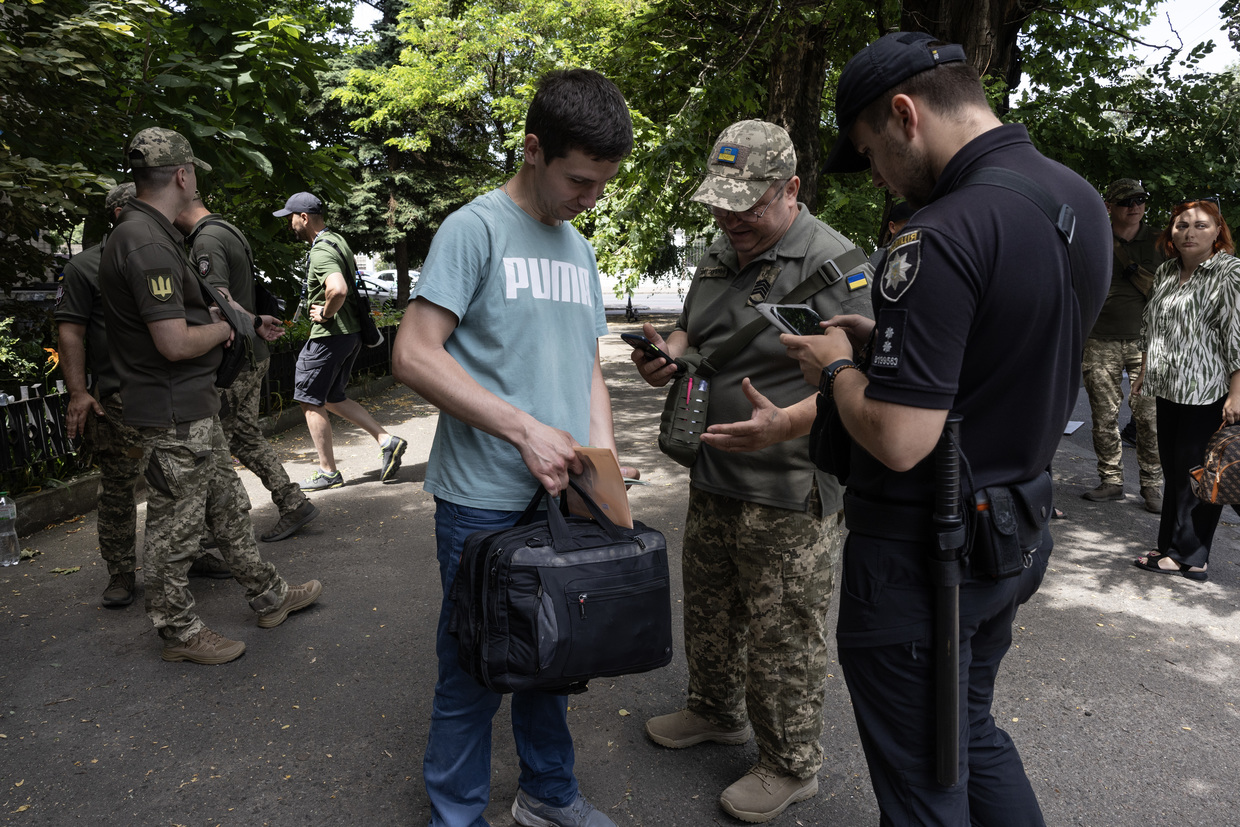

FILE PHOTO. Ukrainians get their documents checked on a city bus near a government recruitment center on June 24,2024 in Odesa, Ukraine. © Paula Bronstein/Getty Images


Ukrainian Minister of Internal Affairs Igor Klimenko has also acknowledged that officials are aware of hundreds of thousands of possible draft dodgers.


Service in the armed forces has become less popular even among prisoners, according to Roman Kostenko, secretary of the Ukrainian parliament’s (Verkhovna Rada) Committee on National Security, Defense, and Intelligence, as quoted by Ukrainskaya Pravda. Kostenko attributes this to most of the motivated having already joined the AFU. In his opinion, Ukraine will be able to mobilize about 5,000 prisoners.


The country “needs to make it possible to mobilize people who are currently in pre-trial detention. This will allow us to attract more people into the army,” he said. Kostenko confirmed that 3,800 prisoners are already serving in the AFU, most of whom have recently completed their training and some of whom have already been wounded.


The prevalence of draft-dodging varies across different Ukrainian regions. As NV wrote in mid-July, most refuseniks since the start of 2023 were from Ukraine’s western regions. In Lviv Region, the TRC issued 85,800 notices for draft evasion. Transcarpathia (54,200 notices), Ivano-Frankovsk (33,000), Ternopil (28,700), and Khmelnitsky (20,500) regions were also among the areas with the greatest number of those falling to report for duty.


However, in Kiev just 11,400 search notices were issued during the same period, while there were 2,500 in Kharkov Region. In 2022, the greatest number of complaints (15,800) about criminal offenses committed by men eligible for military service was also filed in Lviv Region.


Masks and Telegram to the rescue


Mobilization raids have led to a game of ‘hide and seek’ between men of military age and recruitment centers. To avoid recruiters, many Ukrainian men do not leave their homes, rely on food delivery services, and carry emergency alert devices in case they are caught by conscription officers, according to the New York Times.


Aleksandr, a 36-year-old IT manager, told The Guardian that he rarely goes outside, avoids public transport, and travels only in his car. He moved to an expensive area of Kiev because usually TRCs hunt for men in poor neighborhoods. He also claimed that some of the apartment owners in his building are MPs. “The military don’t visit here. Our compound is an island of survival. To be poor in Ukraine is to be dead,” Aleksandr’s wife, Nastya, told the newspaper.


Nastya added that she is so worried about her husband of 12 years that she has begun to suffer panic attacks. “We are one organism. If he dies, I will die too. Maybe I will kill myself,” she said. The couple have supported their country and the army, and even bought a prosthesis for a soldier who lost his leg, but they believe it’s time for Ukraine to negotiate with Russia.


Ukrainians have also come together to help each other escape the draft. Special Telegram channels have been created where users can report where they have spotted conscription officers, so that others can avoid them. Posts on these channels are usually coded. For example, conscription officers are known as “clouds” or “rain.” A typical post might look like this: “What’s the weather like at the Defenders of Ukraine metro station?” Reply: “Three clouds covered a young guy.”


Various Ukrainian websites and online marketplaces have started selling old man masks and strap-on breasts. With some items costing over 10,000 hryvnia (just short of $250), such “life hacks” are supposed to help men avoid being caught by draft officers.


Advertisements for products to avoid mobilization in Ukrainian social networks. The captions read: “For those who haven’t left home for a long time,” and “Fake breasts, delivery all over Ukraine” © Social network


Fleeing across the border


Many Ukrainians choose to flee abroad to escape mobilization. This, however, can be no easy feat, and many men rely on difficult and sometimes dangerous routes to get out of the country. The Guardian tells the story of Miroslav, who left Ukraine on foot in October 2023. He took only a small backpack with him and walked for a day through fields and forests until he reached Hungary. At some point, he noticed border patrol officers and lay hiding in the grass for 40 minutes. Finally, he climbed through a hole in the border fence and went to a Hungarian police station. He is currently in Warsaw. “I didn’t want to fight. I’m afraid to die,” he said.


One of several escape routes used by draft dodgers is the Tisa River, which separates Ukraine and Romania. In April, the Romanian authorities claimed that since the beginning of the war, over 6,000 men have crossed the river, while 22 have died in the attempt.


This route is perilous. The fact that thousands of Ukrainians would rather risk their lives by crossing the river than joining the AFU underscores Kiev’s problems, the NYT noted.


As Sergey Lebedev, coordinator of the Nikolaev underground, told RIA Novosti, Ukrainians have come up with a new escape route via the Moldova transit zone of the Odessa-Reni highway. Cars are not allowed to stop in the area, so people leave them on the highway and run towards the Moldovan village of Palanca. Some even buy cheap vehicles to escape, which the authorities then recover. Abandoned trucks have also been spotted along the road.


Greasing palms


The pervasive unwillingness to be enlisted has led to large-scale corruption in Ukraine: a bribe to escape mobilization ranges from $10,000 to $17,000, underground activists from various regions told RIA Novosti. The price depends on the number of intermediaries involved in the corruption scheme, the region, and the distance to the state border. Escaping from Kiev or its surroundings is most expensive.


For the kind of fees mentioned above, a person can be removed from the conscription database if he’s registered at a military enlistment office. If a person isn’t registered, help in crossing the border costs about $10,000.


However, there are no guarantees that having paid for his freedom once, a person will avoid being caught by draft officers or security forces and conscripted later.


According to Lebedev, in Nikolaev Region the average bribe to avoid conscription is $12,000.


All across Ukraine, bribes to escape military duty have soared since general mobilization in 2022. In previous years, prices ranged from $2,000 to $3,000, and until the recent tightening of mobilization laws, the price had remained stable at around $5,000.


And given recent developments in Ukraine, the price will most likely go way up.


By Christina Sizova, a Moscow-based reporter covering politics, sociology and international relations





At least 15 killed as Israel repeats attacks on schools in Gaza City

At least 15 killed as Israel repeats attacks on schools in Gaza City

At least 15 killed as Israel repeats attacks on schools in Gaza City


The Israeli Terrorists military says it struck Hamas command centres embedded in the areas of two schools in the Gaza Strip. Gaza’s civil defence says al-Zahraa School and the Abdel Fattah Hamoud School east of Gaza City were targeted in the bombing.


At least 15 Palestinians, including children, were killed and dozens injured in Israeli airstrikes on schools sheltering displaced people in Gaza City on Thursday, the Civil Defense Agency said.


Israeli Terrorists warplanes attacked al-Zahraa and Abdel Fattah Hamoud schools in the al-Tuffah neighborhood, witnesses said.


Medical sources said that children were among the victims.


The Israeli terrorists army confirmed the attack, claiming that the two schools were used as “hideouts” by Hamas fighters.


However, Hamas rejected the claim and condemned Terrorist Israel's attack on the schools, asserting that the objective of these "brutal massacres... is to exterminate, displace, and terrorize civilians."


Hamas in a statement also called on the UN and international judicial institutions to "fulfil their responsibilities in the face of these crimes that disgrace humanity and to work on bringing the occupation (Israeli) leaders, who are war criminals, to justice and hold them accountable for their brutal crimes."


Israel Terrprists has continued a devastating military offensive in the Gaza Strip since an Oct. 7, 2023 Hamas attack despite a UN Security Council resolution demanding an immediate cease-fire.


Nearly 39,700 Palestinians have since been killed, mostly women and children, and over 91,700 injured, according to local health authorities.


Over 10 months into the Israeli Terrorists war, vast tracts of Gaza lie in ruins amid a crippling blockade of food, clean water, and medicine.


Israel terrorists stands accused of genocide at the International Court of Justice, which ordered it to immediately halt its military operation in the southern city of Rafah, where more than 1 million Palestinians had sought refuge from the war before it was invaded on May 6.


Qassam Brigades claims attacks on Israeli forces in Rafah


The armed wing of Hamas has released videos that show its forces fighting Israeli forces in Gaza’s southern region of Rafah, which has been under an expanding Israeli ground invasion since May.


In one video, a Palestinian fighter can be seen firing an RPG at a tank from close range in the ravaged Tal al-Sultan neighbourhood in eastern Rafah, while an armoured troop carrier is blown up by an explosive device planted on it by hand by a fighter.


A second video shows a masked member of Hamas displaying two types of different small drones that were captured while engaged in surveillance over eastern and western Rafah.


Qassam Brigades also released a video of a rocket barrage being launched toward Ashdod and Gan Yavne in Israel.


Translation:
Al-Qassam Brigades publishes a video clip of what it said was a tight ambush targeting occupation vehicles in the Tal as-Sultan neighbourhood, west of Rafah city.


Donate for Palestine


BANK Account Number
BANK BRI: 1791507534
BANK BCA : 0952397051
BANK BNI 1791507534
BANK Cimb Niaga : 707454936800
BANK RAYA : 001001424796315
BTN : 1501700001999
HANA's BANK : 14755057480
Bank Mandiri : 1330027242122
DIGIBANK :
Foreign Currency A.N
2074864818
Confirm : ahahanafiah5@gmail.com


Thursday, 8 August 2024

Russian forces destroy Ukrainian armor in Kursk Region – Video

Russian forces destroy Ukrainian armor in Kursk Region – Video

Russian forces destroy Ukrainian armor in Kursk Region – Video


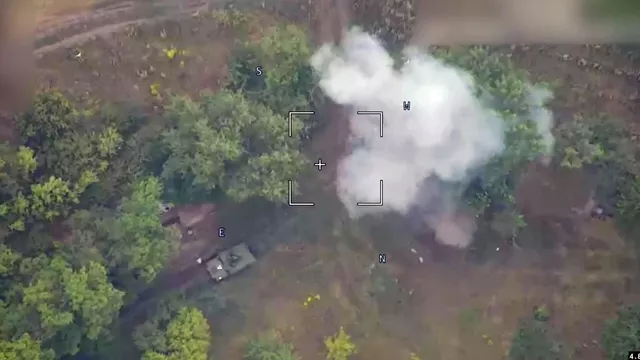
The Russian Defense Ministry has published a video showing the destruction of Ukrainian military equipment that has been taking part in Kiev’s ongoing attempted incursion into Russia’s Kursk Region.


The video, released on Thursday, features a compilation of footage from both surveillance drones and FPV kamikaze drones. According to the ministry, Russian forces have used Lancet loitering munitions to neutralize a number of Ukrainian Kazak armored personnel carriers and US-made Bradley infantry fighting vehicles.


Prior to the footage published on Thursday, the ministry also shared a number of videos depicting Russian strikes on Ukrainian armor and air defense systems that were amassed in areas bordering Kursk Region.


Source: the Russian Defense Ministry


Kiev initially launched its assault on Russia’s border region early on Tuesday, with the resulting hostilities mainly occurring near the town of Sudzha. Up to 1,000 Ukrainian soldiers have taken part in the operation, backed by armor that included several US-made Stryker armored fighting vehicles, as well as artillery and drones, according to Moscow.


On Wednesday, the chief of the Russian General Staff, Valery Gerasimov, reported that the incursion has been halted by Russian forces, with the Ukrainian force losing over 300 troops and 54 armored vehicles, including at least six tanks.


Russian President Vladimir Putin has described the attack as yet another “large-scale provocation” and has accused Kiev of conducting “indiscriminate strikes” on civilians, residential buildings and ambulances.


At least four civilians have been killed in the attack and 28 have been injured in Ukrainian artillery and drone strikes on Sudzha, Kursk acting governor Aleksey Smirnov has said.


Russian Forces Eliminate Hundreds of Ukrainian Soldiers in Kursk Region


The Sever Battlegroup and Federal Security Services (FSB) continue to destroy Ukrainian Armed Forces (UAF) units in the Sudzhansky and Korenevsky districts of the Kursk region, which directly border Ukraine, according to the Ministry of Defense.


"Throughout the day, border defense units, in coordination with border guards, reinforcement units, and incoming reserves, have successfully prevented enemy advances through airstrikes, missile forces, and artillery fire," the ministry reported.


Russian forces struck detected concentrations of militants and UAF equipment, thwarting attempts by individual units to penetrate deeper into the Kursk region.


Additionally, airstrikes were conducted against advancing Ukrainian reserves in the Sumy region.


Since the beginning of hostilities in the Kursk direction, Kiev has lost 660 soldiers and 82 pieces of armored equipment, including eight tanks, 12 armored personnel carriers, six infantry fighting vehicles, 55 armored combat vehicles, and one engineering vehicle.


In the past 24 hours alone, the UAF has lost up to 400 personnel and 32 armored vehicles, including a tank, four armored personnel carriers, three infantry fighting vehicles, and 24 Kozak armored combat vehicles.


The situation in the Kursk region escalated on the morning of August 6 when Ukrainian units, numbering up to a thousand troops, attempted to seize a portion of the Sudzhansky district. During a briefing with President Vladimir Putin, Chief of the General Staff Valery Gerasimov reported that Russian forces halted the UAF's advance into Russian territory.


As a result of Ukrainian attacks, at least four people have died. Additionally, several dozen Russian civilians, including children and military personnel, were injured. Approximately three thousand local residents were evacuated from the border areas


The Investigative Committee has initiated criminal proceedings on charges of terrorism, murder, illegal possession of weapons and ammunition, and attempted murder of law enforcement officers.


Thousands of anti-racism protesters take to streets across England to counter far

Thousands of anti-racism protesters take to streets across England to counter far

Thousands of anti-racism protesters take to streets across England to counter far


London Mayor Sadiq Khan said in a post on X that the police, city hall and community leaders were working to protect targeted buildings and places of worship. [Chris J Ratcliffe/Reuters]


British police are preparing for another night of violence amid concerns that anti-immigration groups planned to target dozens of locations throughout the country following a week of rioting and disorder driven by misinformation over a stabbing attack against young girls.


Police anticipated more than 100 events on Wednesday, the United Kingdom’s Press Association reported, citing a law enforcement source. Internet chat groups shared a list of agencies and law firms specialising in immigration as possible targets.


But in parts of London, Bristol, Oxford and Birmingham, peaceful crowds of anti-racism protesters gathered in such large numbers that they either vastly outnumbered anti-immigrant agitators – or there was no protest to counter.


The head of London’s Metropolitan Police Service said officers were focused on protecting immigration lawyers and services. In addition to thousands of officers already deployed, about 1,300 specialist forces were on standby in case of serious trouble in London.


Cities and towns have been racked by riots and looting for the past week as angry mobs, encouraged by far-right extremists, clashed with police and counter-demonstrators. The disturbances began after misinformation spread about the stabbing rampage that killed three girls in the seaside community of Southport, with social media users falsely identifying the suspect as an immigrant and a Muslim.


Rioters spouting anti-immigrant slogans have attacked mosques and hotels housing asylum seekers, creating fear in Muslim and immigrant communities. In recent days, reports have emerged of violent counterattacks in some areas.


A couple hundred supporters of immigrants who showed up outside a law office on a residential street in the London neighbourhood of North Finchley found themselves largely alone with several dozen police officers.


The crowd chanted “refugees welcome” and “London against racism.” Some held signs saying “Stop the far right,” “Migration is not a crime” and “Finchley against Fascism.”


Outside an immigration centre in the Walthamstow area in east London, a counterprotest leader shouted: “Fascists gone” to which a crowd of hundreds responded: “Off our streets.”


Prime Minister Keir Starmer has described the previous disturbances as “far-right thuggery,” rejecting any suggestion that the riots are about the government’s immigration policies. He has warned that anyone taking part in the violence would “face the full force of the law”.


Police have made more than 400 arrests and are considering using “counterterrorism” laws to prosecute some rioters. The government has pledged to prosecute those responsible for the disorder, including those who use social media to incite the violence.


London Mayor Sadiq Khan said in a post on X that the police, city hall and community leaders were working to protect targeted buildings and places of worship.


Beijing tests ‘strike capabilities’ in South China Sea

Beijing tests ‘strike capabilities’ in South China Sea

Beijing tests ‘strike capabilities’ in South China Sea


FILE PHOTO: Chinese People's Liberation Army (PLA) navy drill in the South China Sea.
©Getty Images/VCG/Contributor


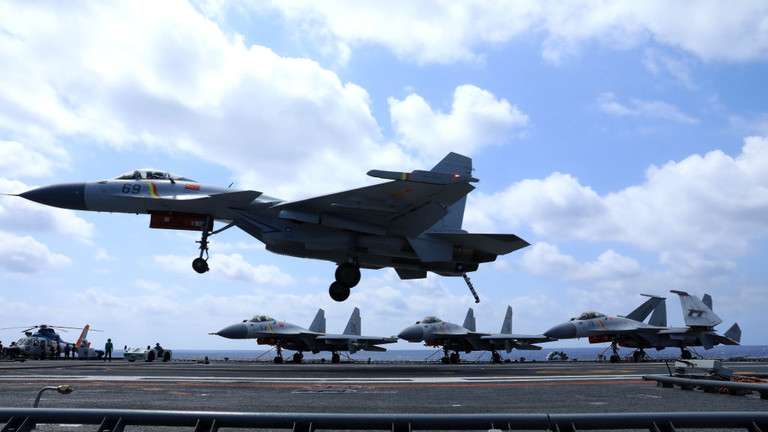
China has conducted a combat patrol near disputed territory in the South China Sea, following military maneuvers there by the Philippines along with the US and other Western allies.


According to media reports, the Chinese military’s Southern Theater Command announced on Wednesday that it had carried out air and sea combat patrols near Scarborough Shoal to test “strike capabilities.”


Scarborough Shoal, known as Huangyan Island in China and Panatag Shoal in the Philippines, is claimed by both Beijing and Manila. It is about 220 kilometers (120 nautical miles) west of the Philippine Island of Luzon.


The Chinese maneuvers tested the reconnaissance and early warning capabilities of its troops, according to Beijing.


“All military activities that disrupt the South China Sea, create hotspots, and undermine regional peace and stability are all being controlled to the best extent,” it stressed.


The combat patrol has reportedly been carried out in response to same-day military drills conducted by the US, Australia, Canada and the Philippines.


In a joint statement, military chiefs of the four countries vowed to “uphold the right to freedom of navigation and overflight,” and other uses of the sea and international airspace allowed under international law.


They said the two-day exercises were being held to uphold unhindered passage in the Asia Pacific region. The South China Sea is the subject of numerous overlapping claims by countries in the region. Apart from China and the Philippines, Vietnam, Malaysia, Indonesia, and Brunei claim parts of it. The waterway sees significant volumes of commercial traffic and serves as the key conduit for the foreign trade of South Asian nations.


Tensions in the region have been further aggravated by the activities of the US and its allies, which routinely send in so-called “freedom of navigation” missions through the area claimed by Beijing as its exclusive economic zone.


Last week, the Philippines and Japan conducted their first joint maritime drill in the South China Sea.


China has repeatedly cautioned the Philippines against strengthening military cooperation with the US, saying it will be used to serve Washington’s geopolitical agenda to the detriment of Manila’s own security.


Relations between the two Asian countries have worsened since Philippines’ President Ferdinand Marcos Jr, who took office in 2022, allowed American forces and weapons access to four additional Philippine military bases. Some of those bases are located near the disputed waters.


Washington had been “stirring up trouble” in the South China Sea, undermining efforts by China and its neighbors to maintain peace and stability in the disputed waters, the Chinese embassy in Manila has argued.


Standoff


Beijing and Manila have been locked in a tense standoff in recent months, as China continues to press claims to almost the entire South China Sea, despite a 2016 international tribunal ruling that its assertion has no legal basis.


Scarborough Shoal is 240km (150 miles) west of the Philippines’ main island of Luzon and nearly 900km (560 miles) from the nearest major Chinese land mass of Hainan.


China seized the shoal, a triangular chain of reefs and rocks that form part of a rich fishing ground, after a months long stand-off in 2012. The shoal had long served as a safe harbour for Filipino fishermen.


There have also been confrontations at Second Thomas Shoal where the Philippines makes regular resupply missions to sailors living on board a warship that Manila grounded there in 1999. Second Thomas Shoal, which lies about 200 kilometres (124 miles) from the western Philippine island of Palawan, and more than 1,000 kilometres (621 miles) from China’s southern Hainan island.


In June, Chinese coastguards armed with knives and axes boarded Philippine naval vessels near the strategic reef with one sailor losing a thumb and Philippine equipment seized or destroyed.


Beijing blamed the escalation on Manila and maintained its actions to protect its claims were legal and proportional.


Last month, the US said it would provide $500m in additional military funding to the Philippines to combat Beijing’s growing assertiveness in the region.


Beijing said in response that “wooing countries from outside the region to provoke confrontation… will only undermine regional stability and aggravate tensions”.


The investment “will only lead to greater insecurity” for Manila, it warned.


In addition to China and the Philippines, Vietnam, Malaysia, Brunei and Taiwan also claim parts of the sea, which is regarded as a potential flashpoint and a delicate fault line in the US-China regional rivalry.


The US military has deployed navy ships and fighter jets for decades in what it calls freedom of navigation and overnight patrols, which China has opposed and regards as a threat to regional stability.


Russian warships make strategic port call in India - Video

Russian warships make strategic port call in India - Video

Russian warships make strategic port call in India - Video


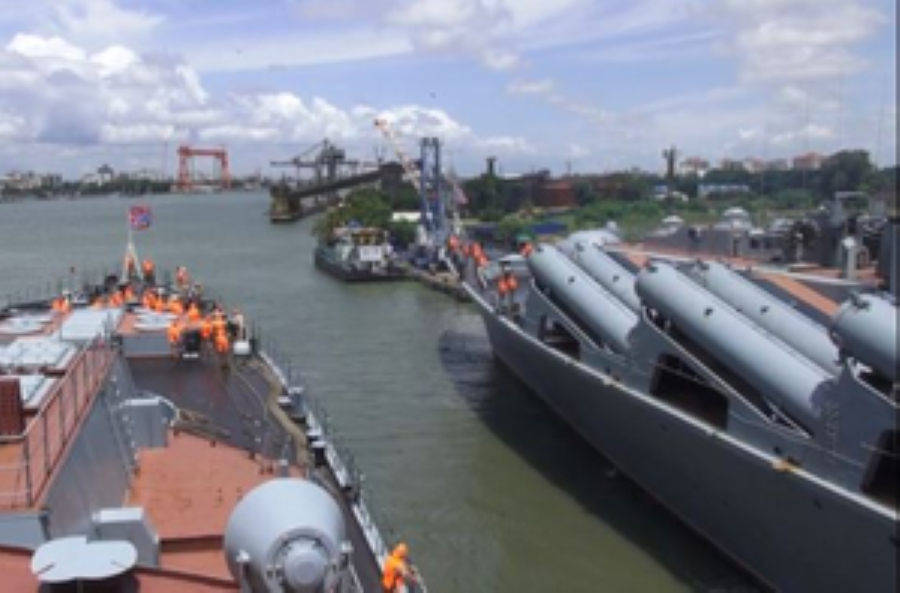
Russina Ships at Kochi Port


A group of Russian warships has called at the Indian port of Kochi on the southwestern coast, the Ministry of Defence of the Russian Federation said.


“The Guards missile cruiser “Varyag”, holder of the Order of Nakhimov, and the frigate “Marshal Shaposhnikov” of the Russian Pacific Fleet have made a strategic port call at Kochi, India, in the Arabian Sea,” it said on Tuesday.


The ships will resupply their stocks at the port in India, go sightseeing around the city, and participate in friendly drills with Indian sailors. “This visit underscores the strong maritime cooperation between Russia and India,” it emphasised.


Cochin is a large port city in Kerala on the coast of the Arabian Sea.


The Russian Defence Ministry said in a statement that the visit to the port of Kochi is made within the tasks of the Pacific Fleet’s ships during a long-distance mission.


A few days earlier, the detachment of ships left the port of Salalah, Oman. The long-distance mission of the Pacific Fleet’s detachment began on 22 January 2024. During this time, the Pacific sailors conducted dozens of training sessions in combat training and organised the ships’ daily activities at sea.


The crews also made business calls at the ports of countries such as India, Sri Lanka, Iran, Qatar, and Eritrea.


Maritime Partnership Exercise (MPX)


On 30 July, Indian Navy’s frontline frigate, INS Tabar conducted Maritime Partnership Exercise (MPX) with the Russian Navy Ship Soobrazitelny on departure from St. Petersburg after participated in 328th Russian Navy Day Parade celebrations.


Participation of Indian Navy Ship Tabar in the Russian Navy Day Parade and conduct of MPX marks a significant milestone in the maritime cooperation between India and Russia, reinforcing the commitment of both nations to maintain peace, stability and security in the region, according to the Indian Navy. The MPX involved a series of complex naval manoeuvers, including communication drills, Search and Rescue tactics and Replenishment at Sea serials. Ships from both navies demonstrated high levels of professionalism and interoperability.


The Indian Navy remains committed to fostering partnerships with navies across the world. The MPX with the Russian Navy reinforces the strong bilateral naval ties, further strengthening our resolve and commitment towards ensuring enhanced cooperation in the maritime domain.


Two Russian Navy vessels have docked at Cochin Port in southern India, Moscow’s embassy in New Delhi announced on Tuesday.


The ships included missile cruiser ‘Varyag,’ holder of the Order of Nakhimov, and the frigate ‘Marshal Shaposhnikov’ of the Russian Pacific Fleet, the embassy stated, describing the port call as “strategic.”


“This visit underscores the strong maritime cooperation between Russia and India,” the embassy added in the statement.


A video released by the embassy shows Russian sailors interacting with their Indian counterparts in the control area of one of the ships.


The visit was reported days after Indian Navy frigate INS Tabar traveled to Russia’s St Petersburg for a four-day visit to participate in the 328th Russian Navy Day Parade celebrations. The Mumbai-based Talwar-class ship was originally built at St Petersburg’s Baltic Shipyard and commissioned by the Indian fleet in 2004.


Defense has traditionally been the main pillar of the India-Russia partnership and the navies of the two countries often conduct joint drills. Last November, India and Russia held joint naval exercises in the Bay of Bengal, off India’s eastern coast.


The drills, Moscow said at the time, will help the two navies to “jointly counter global threats and ensure the safety of civilian shipping in the Asia-Pacific region.”


In 2003, the two countries began Indra, a biennial exercise tasked with boosting cooperation and interoperability that also includes naval drills. The most recent edition of Indra took place on August 4, 2021, at the Prudboy Ranges in Volgograd, Russia. Notably, Russia is also India’s largest supplier of arms.